
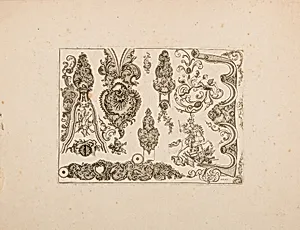
Plate Nine from Nouveavx Desseins D'Arquebvseries
dated 1743
Medium
Engraving
Dimensions
sheet: 11 3/4 x 9 1/8 in. (29.8 x 23.2 cm); plate: 7 1/4 x 5 1/4 in. (18.4 x 13.3 cm)
Classification
Works on Paper-Engravings
Culture
French, Paris
Department
Arms and Armor
Museum
Metropolitan Museum of Art, New York, NY
Credit
Purchase, Arthur Ochs Sulzberger Gift, 2016
Accession Number
2016.403.6
Rights
Public Domain
Tags
Art Historical Context
Step into the ornate world of 18th-century French arms design with *Plate Nine from Nouveaux Dessins d'Arquebusiers* by Gilles Demarteau, an exquisite engraving dated 1743. Created in Paris during the lavish Rococo era, this work belongs to a series of innovative patterns for decorating arquebus stocks—early firearms carried by soldiers and hunters. Housed in the Metropolitan Museum of Art's Arms and Armor Department, it measures a compact 11 3/4 x 9 1/8 inches on the sheet, showcasing Demarteau's mastery as a pioneering engraver known for his precise reproductive techniques. Demarteau, a leading figure in Parisian printmaking, captured the era's fascination with elaborate ornamentation, blending floral motifs, scrolls, and grotesque elements typical of French decorative arts. These designs weren't just aesthetic; they elevated functional weapons into status symbols for the nobility, reflecting the cultural prestige of finely crafted arms amid Europe's military and hunting traditions. As a work on paper, this engraving highlights the technical brilliance of intaglio printing, where intricate lines were incised into a metal plate for rich, detailed impressions. Acquired through the Arthur Ochs Sulzberger Gift in 2016, it invites visitors to appreciate how art intertwined with weaponry, turning cold steel into scrolling elegance.
About the Artist
Gilles Demarteau · 1729–1776
Gilles Demarteau the Elder, born on January 19, 1722, in Liège, began his career steeped in the craft of metalwork. The son of a gunsmith, he learned engraving and goldsmithing from his father before moving to Paris around 1748–1750 to join his brother, who worked as a goldsmith for the engraver De Lacollombe, renowned for firearm ornament designs. Demarteau trained in De Lacollombe's workshop as ...