
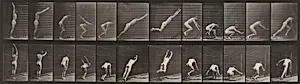
Plate Number 162. Jumping, standing broad jump
Medium
collotype
Dimensions
image: 13.3 × 46.2 cm (5 1/4 × 18 3/16 in.) sheet: 48.2 × 61.1 cm (19 × 24 1/16 in.)
Classification
Photograph
Department
CPH
Museum
National Gallery of Art, Washington, D.C.
Credit
Corcoran Collection (Museum Purchase, 1887)
Accession Number
2015.19.4105
Rights
Public Domain
Art Historical Context
Eadweard Muybridge’s *Plate Number 162. Jumping, standing broad jump* belongs to his landmark 1887 publication *Animal Locomotion*, a monumental study of human and animal movement. Working at the University of Pennsylvania, Muybridge employed banks of cameras triggered in rapid succession to freeze motion too fleeting for the eye to register The resulting sequences transformed both scientific inquiry and visual culture, laying groundwork for the invention of cinema. Printed as a collotype—a process prized for its rich tonal range and fidelity—this long, horizontal sheet presents twelve consecutive phases of a man executing a standing broad jump. Viewers can trace the subtle shifts in weight, the arc of the arms, and the precise moment the feet leave the ground. Such analytical clarity was revolutionary in an era when artists and scientists still debated how bodies actually moved. Acquired by the Corcoran Gallery the same year it was published, the plate remains a compelling reminder of photography’s power to expand perception. It invites us to slow down and witness the hidden poetry of ordinary action.
About the Artist
Eadweard Muybridge · 1830–1904
Eadweard Muybridge (1830-1904) was an English-American photographer who revolutionized the understanding of motion through his pioneering chronophotographic studies. Born Edward James Muggeridge in Kingston upon Thames, England, he emigrated to America and became famous first for his dramatic landscape photographs of Yosemite Valley, then for his groundbreaking motion studies that proved horses li...