
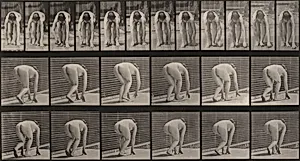
Plate Number 184. Walking on hands and feet
Medium
collotype
Dimensions
image: 19.6 × 36.5 cm (7 11/16 × 14 3/8 in.) sheet: 48.3 × 61.15 cm (19 × 24 1/16 in.)
Classification
Photograph
Department
CPH
Museum
National Gallery of Art, Washington, D.C.
Credit
Corcoran Collection (Museum Purchase, 1887)
Accession Number
2014.79.228
Rights
Public Domain
Art Historical Context
Step into the groundbreaking world of motion capture with *Plate Number 184. Walking on hands and feet* by Eadweard Muybridge, created in 1887. This collotype print, part of Muybridge's seminal *Animal Locomotion* series, freezes a dynamic human figure mid-stride on all fours, showcasing the British-American photographer's obsession with dissecting movement. Produced just as photography evolved from static portraits to scientific inquiry, the image captures sequential poses across a vast 19.6 × 36.5 cm frame, revealing the fluid mechanics of an unconventional gait. Muybridge's collotype technique—a precise photomechanical process—allowed for exquisite detail in mass reproduction, making his 781-plate portfolio accessible to scientists, artists, and the public. Acquired by the Corcoran Gallery in 1887 and now in the National Gallery of Art's Corcoran Collection, this work exemplifies late 19th-century innovation. It bridged art and science, influencing early filmmakers like the Lumière brothers and modern stop-motion animation. Fun fact: Muybridge's experiments began with proving a trotting horse's legs all leave the ground—a myth busted through his sequential exposures. Here, the acrobatic pose invites us to ponder human potential, blending curiosity with visual poetry. (198 words)
About the Artist
Eadweard Muybridge · 1830–1904
Eadweard Muybridge (1830-1904) was an English-American photographer who revolutionized the understanding of motion through his pioneering chronophotographic studies. Born Edward James Muggeridge in Kingston upon Thames, England, he emigrated to America and became famous first for his dramatic landscape photographs of Yosemite Valley, then for his groundbreaking motion studies that proved horses li...