
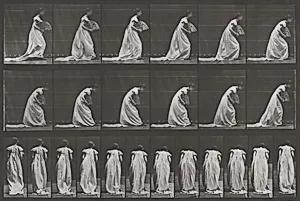
Plate Number 199. Curtesying, a fan in right hand
Medium
collotype
Dimensions
image: 22.9 × 33.95 cm (9 × 13 3/8 in.) sheet: 48.25 × 61.1 cm (19 × 24 1/16 in.)
Classification
Photograph
Department
CPH
Museum
National Gallery of Art, Washington, D.C.
Credit
Corcoran Collection (Museum Purchase, 1887)
Accession Number
2014.79.241
Rights
Public Domain
Art Historical Context
Step into the revolutionary world of Eadwe Muybridge, a British-born photographer whose groundbreaking experiments captured motion like never before. *Plate Number 199.tesying, a fan right hand* (1887) is one plate from his monumental *Animal Locomotion* series, comprising 781otype prints that dissected human and animal movement through sequential photography. Using a battery of up to 24 cameras triggered by electromagnetic shutters, Muybridge froze fleeting actions, proving that a galloping horse lifts all four hooves off the ground—a revelation that bridged science and art. This collotype, a precise photomechanical printing process that allowed faithful reproduction of photographic details on a large sheet (48.25 × 61.1 cm), depicts a figure mid-curtsey, elegantly wielding a fan in her right hand. Such plates explored everyday gestures, including women's poised movements, blending anatomical precision with graceful poise. Muybridge's work, acquired by the Corcoran Gallery in 1887 and now in the National Gallery of Art's collection, influenced early filmmakers like the Lumière brothers and modern stop-motion techniques. Today, this image reminds us how Muybridge transformed photography from static portraiture into a dynamic study of life, forever changing our understanding of time and motion.
About the Artist
Eadweard Muybridge · 1830–1904
Eadweard Muybridge (1830-1904) was an English-American photographer who revolutionized the understanding of motion through his pioneering chronophotographic studies. Born Edward James Muggeridge in Kingston upon Thames, England, he emigrated to America and became famous first for his dramatic landscape photographs of Yosemite Valley, then for his groundbreaking motion studies that proved horses li...