
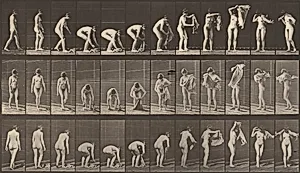
Plate Number 227. Lifting a cloth from the ground, placing it around shoulder and turning
Medium
collotype
Dimensions
image: 20.8 × 36 cm (8 3/16 × 14 3/16 in.) sheet: 48.26 × 60.96 cm (19 × 24 in.)
Classification
Photograph
Department
CPH
Museum
National Gallery of Art, Washington, D.C.
Credit
Corcoran Collection (Museum Purchase, 1887)
Accession Number
2014.79.263
Rights
Public Domain
Art Historical Context
Step into the pioneering world of motion photography with *Plate Number 227: Lifting a cloth from the ground, placing it around shoulder and turning* by Eadweard Muybridge, created in 1887. This collotype print captures a nude figure in a fluid sequence of everyday actions—bending to retrieve a cloth, draping it over the shoulders, and pivoting gracefully. Part of Muybridge's monumental *Animal Locomotion* series, it showcases human movement broken into precise instants, revealing the body's natural rhythm in ways the naked eye could never discern. Muybridge, a British-American photographer, transformed visual art and science in the late 19th century. After proving a horse's gait with sequential shots in the 1870s, he expanded to over 780 plates documenting humans and animals. His work bridged photography, physiology, and early film, influencing pioneers like Thomas Edison and the birth of cinema. These studies weren't just artistic; they aided anatomists, athletes, and engineers in understanding kinetics. Printed via collotype—a meticulous photomechanical process for faithful reproductions—this 20.8 × 36 cm image (on a larger 48 × 61 cm sheet) entered the Corcoran Collection in 1887 and now graces the National Gallery of Art. It's a testament to how one man's curiosity froze time, inviting us to marvel at motion's poetry.
About the Artist
Eadweard Muybridge · 1830–1904
Eadweard Muybridge (1830-1904) was an English-American photographer who revolutionized the understanding of motion through his pioneering chronophotographic studies. Born Edward James Muggeridge in Kingston upon Thames, England, he emigrated to America and became famous first for his dramatic landscape photographs of Yosemite Valley, then for his groundbreaking motion studies that proved horses li...