
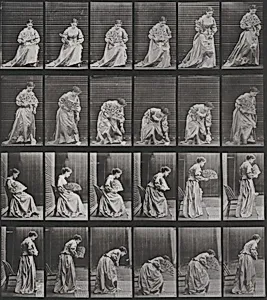
Plate Number 250. Rising from chair, stooping and lifting handkerchief
Medium
collotype
Dimensions
image: 28.5 × 25.5 cm (11 1/4 × 10 1/16 in.) sheet: 47.63 × 60.33 cm (18 3/4 × 23 3/4 in.)
Classification
Photograph
Department
CPH
Museum
National Gallery of Art, Washington, D.C.
Credit
Corcoran Collection (Museum Purchase, 1887)
Accession Number
2014.79.281
Rights
Public Domain
Art Historical Context
Eadweard Muybridge *Plate Number 250: from Chair, Stooping and Lifting Handkerchief* (1887) is a captivating snapshot from his seminal *Animal Locomotion* series, comprising 781 plates produced at the University of Pennsylvania. This collotype print freezes a sequence of human movement: a nude model rises from a chair, stoops low, and lifts a handkerchief in a fluid, everyday action. Muybridge, a British-American photographer, pioneered high-speed photography in the 1870s, using banks of up to 24 cameras triggered by electro-mechanical devices to dissect motion frame by frame. The plate's historical significance lies in its role bridging science and art. Commissioned to settle debates on animal gait (famously proving a trotting horse lifts all four hooves off the ground), Muybridge extended his experiments to humans, influencing physiologists like Étienne-Jules Marey, painters like Thomas Eakins, and the birth of cinema through pioneers like the Lumière brothers. These studies challenged perceptions of the body in motion, blending empirical precision with aesthetic grace. Printed via collotype—a 19th-century photomechanical process yielding exquisite tonal detail—this 28.5 × 25.5 cm image is part of the National Gallery of Art's Corcoran Collection (Museum Purchase, 1887). It invites visitors to ponder how Muybridge's innovations forever changed how we see—and capture—life's rhythms.
About the Artist
Eadweard Muybridge · 1830–1904
Eadweard Muybridge (1830-1904) was an English-American photographer who revolutionized the understanding of motion through his pioneering chronophotographic studies. Born Edward James Muggeridge in Kingston upon Thames, England, he emigrated to America and became famous first for his dramatic landscape photographs of Yosemite Valley, then for his groundbreaking motion studies that proved horses li...