
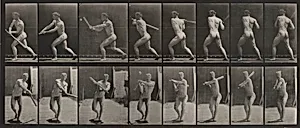
Plate Number 278. Baseball, batting
Medium
collotype
Dimensions
image: 18.3 × 42.4 cm (7 3/16 × 16 11/16 in.) sheet: 48.3 × 61.1 cm (19 × 24 1/16 in.)
Classification
Photograph
Department
CPH
Museum
National Gallery of Art, Washington, D.C.
Credit
Corcoran Collection (Museum Purchase, 1887)
Accession Number
2014.79.305
Rights
Public Domain
Art Historical Context
Step into the dynamic world of 19th-century motion capture with *Plate Number 278., batting* by Eadweard Muy, created in 1887. This collotype print, part of Muybridge's monumental *Animal Locomotion*, freezes a baseball batter mid-swing in a sequence of 12 sequential images across a panoramic sheet measuring 48.3 × 61.1 cm. Captured at the University of Pennsylvania, it showcases an athlete in everyday action, blending science and art to dissect human movement with unprecedented precision. Muybridge, a British-American photographer and pioneer of stop-motion photography, revolutionized visual studies after proving a horse's gallop leaves all hooves off the ground. Using banks of up to 24 cameras triggered by tripwires, he produced over 780 plates like this one, influencing early cinema, animation, and sports science. The collotype medium—a finely detailed printing process—allowed mass reproduction of these high-fidelity images, making scientific insights accessible. Today, housed in the National Gallery of Art's Corcoran Collection, this plate not only celebrates America's growing passion for baseball but also embodies the era's fusion of technology and curiosity, inviting us to marvel at the poetry of motion frozen in time.
About the Artist
Eadweard Muybridge · 1830–1904
Eadweard Muybridge (1830-1904) was an English-American photographer who revolutionized the understanding of motion through his pioneering chronophotographic studies. Born Edward James Muggeridge in Kingston upon Thames, England, he emigrated to America and became famous first for his dramatic landscape photographs of Yosemite Valley, then for his groundbreaking motion studies that proved horses li...