
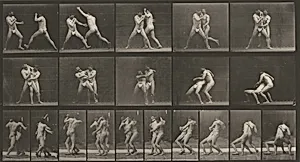
Plate Number 331. Boxing, stop for cross-buttocks
Medium
collotype
Dimensions
image: 20.3 × 37.25 cm (8 × 14 11/16 in.) sheet: 47.9 × 60.35 cm (18 7/8 × 23 3/4 in.)
Classification
Photograph
Department
CPH
Museum
National Gallery of Art, Washington, D.C.
Credit
Corcoran Collection (Museum Purchase, 1887)
Accession Number
2014.79.356
Rights
Public Domain
Art Historical Context
Step into the groundbreaking world of motion photography with *Plate Number 331. Boxing, stop for cross-buttocks by Eadweard Muybridge, created in 1887. This collotype print, part of his monumental *Animal Locomotion*, captures two boxers frozen mid-action during a precise moment—a "stop for cross-bocks," highlighting the dynamic twist and tension of the sport. Measuring 20.3 × 37.25 cm in its image area, it exemplifies Muybridge's pioneering use of sequential photography to dissect human movement, blending art and science. Muybridge, a British-born innovator, revolutionized visual culture after proving a horse's gallop leaves all hooves off the ground in the 1870s. By 1887, he had photographed over 780 subjects across 11,000 negatives using banks of up to 24 cameras triggered by electro-mechanical trips. This plate, acquired via the Corcoran Collection for the National Gallery of Art, underscores his influence on early cinema, modern dance, and biomechanics, turning everyday actions into revelations of grace and power. As a collotype—a meticulous printing technique yielding rich tonal depth—this work invites viewers to ponder the origins of moving images, bridging 19th-century curiosity with today's digital age. A testament to Muybridge's obsessive genius, it reminds us how a single "stop" can redefine motion itself.
About the Artist
Eadweard Muybridge · 1830–1904
Eadweard Muybridge (1830-1904) was an English-American photographer who revolutionized the understanding of motion through his pioneering chronophotographic studies. Born Edward James Muggeridge in Kingston upon Thames, England, he emigrated to America and became famous first for his dramatic landscape photographs of Yosemite Valley, then for his groundbreaking motion studies that proved horses li...