
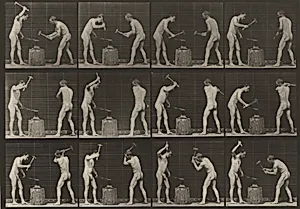
Plate Number 374. Blacksmiths, hammering on anvil
Medium
collotype
Dimensions
image: 22.4 × 31.9 cm (8 13/16 × 12 9/16 in.) sheet: 47.7 × 60.3 cm (18 3/4 × 23 3/4 in.)
Classification
Photograph
Department
CPH
Museum
National Gallery of Art, Washington, D.C.
Credit
Corcoran Collection (Museum Purchase, 1887)
Accession Number
2014.79.395
Rights
Public Domain
Art Historical Context
Eadweard Muybridge’s “Plate Number 374. Blacksmiths, hammering on anvil” belongs to his landmark 1887 publication *Animal Locomotion*, a monumental study of human and animal movement. Working at the University of Pennsylvania, Muybridge arranged banks of cameras with precisely timed shutters to capture sequential phases of action that the naked eye could not perceive. The resulting collotype print freezes three blacksmiths mid-swing, their hammers arrested at different points in the arc, revealing the coordinated rhythm of labor. The medium itself is significant: collotype allowed Muybridge to reproduce the delicate photographic detail at a scale suitable for both scientific scrutiny and artistic study. Measuring roughly nine by thirteen inches within a much larger sheet, the plate invites viewers to examine subtle shifts in posture, muscle tension, and tool position—details that transformed contemporary understanding of how bodies move through space. Muybridge’s sequences profoundly influenced late-nineteenth-century art and the emerging technology of cinema. Painters such as Edgar Degas and later the Futurists drew inspiration from his analytic vision, while the stop-action technique he perfected laid groundwork for motion pictures. Today the image stands as both a scientific document of industrial work and a striking example of photography’s power to expand human perception.
About the Artist
Eadweard Muybridge · 1830–1904
Eadweard Muybridge (1830-1904) was an English-American photographer who revolutionized the understanding of motion through his pioneering chronophotographic studies. Born Edward James Muggeridge in Kingston upon Thames, England, he emigrated to America and became famous first for his dramatic landscape photographs of Yosemite Valley, then for his groundbreaking motion studies that proved horses li...