
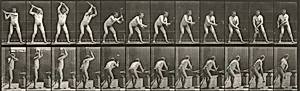
Plate Number 376. Blacksmith, hammering on anvil with two hands
Medium
collotype
Dimensions
image: 13.7 × 44.3 cm (5 3/8 × 17 7/16 in.) sheet: 48.4 × 61.2 cm (19 1/16 × 24 1/8 in.)
Classification
Photograph
Department
CPH
Museum
National Gallery of Art, Washington, D.C.
Credit
Corcoran Collection (Museum Purchase, 1887)
Accession Number
2014.79.397
Rights
Public Domain
Art Historical Context
Eadweard Muybridge’s 1887 collotype captures a blacksmith mid-motion, hammering an anvil with both hands in a fluid sequence. Created as Plate 376 from his groundbreaking *Animal Locomotion* series, the work reflects Muybridge’s systematic study of human and animal movement using multiple cameras triggered in rapid succession. The resulting grid-like composition freezes split-second actions that the naked eye could not perceive, bridging art and scientific inquiry. Printed in collotype—a high-quality photographic process prized for its rich tonal detail—this sheet measures just over 19 by 24 inches, allowing the sequence to unfold across nearly 18 inches of image width. Acquired by the Corcoran Gallery the same year it was made, the photograph exemplifies the late-nineteenth-century fascination with time, motion, and the emerging technology of instantaneous photography. Muybridge’s innovative approach influenced generations of artists and filmmakers, laying essential groundwork for the development of cinema while transforming how motion itself was understood and represented.
About the Artist
Eadweard Muybridge · 1830–1904
Eadweard Muybridge (1830-1904) was an English-American photographer who revolutionized the understanding of motion through his pioneering chronophotographic studies. Born Edward James Muggeridge in Kingston upon Thames, England, he emigrated to America and became famous first for his dramatic landscape photographs of Yosemite Valley, then for his groundbreaking motion studies that proved horses li...