
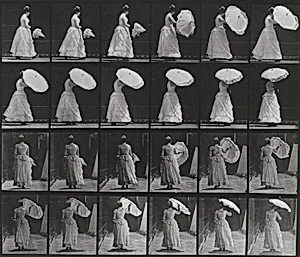
Plate Number 38. Walking and opening a parasol
Medium
collotype
Dimensions
image: 25 × 29.2 cm (9 13/16 × 11 1/2 in.) sheet: 48.35 × 61.1 cm (19 1/16 × 24 1/16 in.)
Classification
Photograph
Department
CPH
Museum
National Gallery of Art, Washington, D.C.
Credit
Corcoran Collection (Museum Purchase, 1887)
Accession Number
2014.79.90
Rights
Public Domain
Art Historical Context
Step into the pioneering world of motion capture with *Plate Number 38. and opening a parasol (1887), a collotype print by Eadweard Muy. This captivating image is part of his monumental *Animal Locomotion* series comprising 781 plates that dissected human and animal movement through sequential photography. Muybridge, a British-born innovator in the late 19th century used multiple cameras triggered in rapid succession to "freeze" motion, debunking myths like the galloping horse's airborne phase and laying groundwork for modern film. The collotype medium—a photomechanical printing process—allowed for exquisite detail in reproducing these high-speed exposures, with the image measuring 25 × 29.2 cm on a larger 48.35 × 61.1 cm sheet. Here, a figure gracefully walks while unfurling a parasol, her form captured across subtle phases of gait and gesture, revealing the fluid rhythm of everyday action. Acquired through the Corcoran Collection (Museum Purchase, 1887) and now in the National Gallery of Art's photography department, this plate exemplifies Muybridge's scientific artistry. Culturally, it bridges Victorian-era curiosity about the body in motion with emerging technologies, influencing artists like Marcel Duchamp and filmmakers worldwide. A testament to human ingenuity, it invites us to marvel at the poetry hidden in a single step.
About the Artist
Eadweard Muybridge · 1830–1904
Eadweard Muybridge (1830-1904) was an English-American photographer who revolutionized the understanding of motion through his pioneering chronophotographic studies. Born Edward James Muggeridge in Kingston upon Thames, England, he emigrated to America and became famous first for his dramatic landscape photographs of Yosemite Valley, then for his groundbreaking motion studies that proved horses li...