
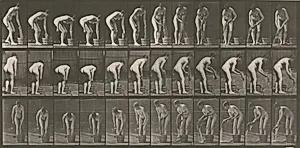
Plate Number 433. Wringing clothes
Medium
collotype
Dimensions
image: 19 × 38.5 cm (7 1/2 × 15 3/16 in.) sheet: 48.2 × 61.2 cm (19 × 24 1/8 in.)
Classification
Photograph
Department
CPH
Museum
National Gallery of Art, Washington, D.C.
Credit
Corcoran Collection (Museum Purchase, 1887)
Accession Number
2014.79.435
Rights
Public Domain
Art Historical Context
Eadweard Muybridge's *Plate Number 433. Wringing Clothes* (1887) captures a sequence of a woman's everyday labor in meticulous detail, part of his groundbreaking *Animal Locomotion* series. This collotype print, reproduced from photographs taken with a battery of 24 cameras synchronized to shutters triggered by the subject's movement, freezes the fluid action of wringing wet fabric into 12 sequential frames. Muybridge, a pioneering photographer, developed these chronophotographic techniques in the 1880s after proving a horse lifts all four hooves off the ground while galloping, revolutionizing scientific and artistic understandings of motion. The large-format sheet (48.2 × 61.2 cm) allowed viewers to study the nuances of human anatomy and kinetics, blending art with emerging fields like physiology and biomechanics. As a collotype—a photomechanical printing process prized for its fidelity—Muybridge's plates bridged photography's documentary precision with reproducible fine art, influencing early filmmakers like the Lumière brothers and modern animation. Today, housed in the National Gallery of Art's Corcoran Collection, this work highlights 19th-century fascination with technology's power to dissect the body in motion, turning mundane tasks into profound studies of grace and effort. A testament to Muybridge's ingenuity, it invites us to marvel at the hidden rhythms of daily life.
About the Artist
Eadweard Muybridge · 1830–1904
Eadweard Muybridge (1830-1904) was an English-American photographer who revolutionized the understanding of motion through his pioneering chronophotographic studies. Born Edward James Muggeridge in Kingston upon Thames, England, he emigrated to America and became famous first for his dramatic landscape photographs of Yosemite Valley, then for his groundbreaking motion studies that proved horses li...