
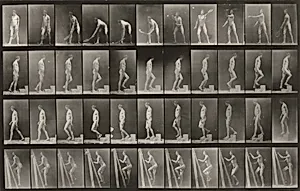
Plate Number 486. A: Lawn tennis. B: Ascending a step. C: Descending a step. D: Ascending a ladder
Medium
collotype
Dimensions
image: 22 × 34.6 cm (8 11/16 × 13 5/8 in.) sheet: 48.26 × 60.96 cm (19 × 24 in.)
Classification
Photograph
Department
CPH
Museum
National Gallery of Art, Washington, D.C.
Credit
Corcoran Collection (Museum Purchase, 1887)
Accession Number
2014.79.476
Rights
Public Domain
Art Historical Context
Eadweard Muybridge’s *Plate Number 486* captures four distinct human actions—playing lawn tennis, ascending a step, descending a step, and climbing a ladder—arranged in sequential frames. Created in 1887 as part of his monumental *Animal Locomotion* series, the collotype print reveals the subtle mechanics of everyday movement that the naked eye cannot perceive. Each small image freezes a fraction of a second, transforming ordinary gestures into a precise visual record. Muybridge, a pioneering photographer and motion-study pioneer, used banks of cameras triggered in rapid succession to dissect motion. His work bridged art and science, influencing painters, sculptors, and later filmmakers by proving that a galloping horse lifts all four hooves off the ground or that a tennis swing involves complex shifts in posture. The large sheet format allowed these studies to function both as scientific documents and striking visual compositions. Printed using the collotype process, which faithfully reproduced the delicate photographic tones, the plate reflects the 19th-century fascination with empirical observation. Acquired by the Corcoran Gallery the same year it was made, this work remains a landmark in the history of photography and the study of human movement.
About the Artist
Eadweard Muybridge · 1830–1904
Eadweard Muybridge (1830-1904) was an English-American photographer who revolutionized the understanding of motion through his pioneering chronophotographic studies. Born Edward James Muggeridge in Kingston upon Thames, England, he emigrated to America and became famous first for his dramatic landscape photographs of Yosemite Valley, then for his groundbreaking motion studies that proved horses li...