
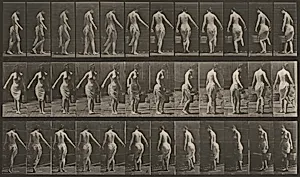
Plate Number 50. Walking and turning around, carrying a bucket of water in left hand
Medium
collotype
Dimensions
image: 21.25 × 35.9 cm (8 3/8 × 14 1/8 in.) sheet: 47.65 × 60.3 cm (18 3/4 × 23 3/4 in.)
Classification
Photograph
Department
CPH
Museum
National Gallery of Art, Washington, D.C.
Credit
Corcoran Collection (Museum Purchase, 1887)
Accession Number
2014.79.102
Rights
Public Domain
Art Historical Context
Eadweard Muybridge *Plate Number 50. and turning around, carrying bucket of water in left* (1887) captures a nude figure in fluid motion, one of 781 plates from his groundbreaking *Animal Locomotion* series Muybridge, a pioneering photographer, used multiple cameras triggered in sequence to "freeze" human and animal movement, debunking myths about gait and turning everyday actions into scientific study. Here, the subject's dynamic turn while balancing a bucket reveals the subtle mechanics of balance and momentum. This collotype print— a precise photomechanical process that reproduced photographic details with exceptional fidelity—allowed Muybridge's images to reach wide audiences beyond original glass negatives. Commissioned by the University of Pennsylvania and purchased by the Corcoran Gallery in 1887, the work bridged art and science, influencing early filmmakers like the Lumière brothers and Eadweard Muybridge's own zoopraxiscope projections. Today, housed in the National Gallery of Art's Corcoran Collection, this plate exemplifies how Muybridge transformed photography from static portraiture to a tool for dissecting time, laying foundational stones for motion pictures and modern biomechanics.
About the Artist
Eadweard Muybridge · 1830–1904
Eadweard Muybridge (1830-1904) was an English-American photographer who revolutionized the understanding of motion through his pioneering chronophotographic studies. Born Edward James Muggeridge in Kingston upon Thames, England, he emigrated to America and became famous first for his dramatic landscape photographs of Yosemite Valley, then for his groundbreaking motion studies that proved horses li...