
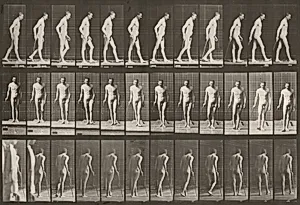
Plate Number 559. Partial paraplegia, walking with cane
Medium
collotype
Dimensions
image: 22.8 × 33.2 cm (9 × 13 1/16 in.) sheet: 48.26 × 60.96 cm (19 × 24 in.)
Classification
Photograph
Department
CPH
Museum
National Gallery of Art, Washington, D.C.
Credit
Corcoran Collection (Museum Purchase, 1887)
Accession Number
2014.79.529
Rights
Public Domain
Art Historical Context
Eadweard Muybridge *Plate Number 559. paraplegia, walking with cane* (1887) is a captivating entry from his groundbreaking *Animal Locomotion* series, a monumental 11-volume publication comprising 781 collotype plates. Pioneering photographer Muybridge, renowned for proving that horses briefly lift all four hooves off the ground during a gallop, turned his lens to human movement in the 1880s. This image captures sequential poses of a figure with partial paraplegia navigating with a cane, blending art, science, and medicine to dissect gait and locomotion. Printed as a large collotype—a precise photomechanical process that faithfully reproduced photographic details on a grand scale (sheet: 48.26 × 60.96 cm)—the plate exemplifies Muybridge's innovative multiple-exposure technique. Using banks of cameras triggered by electro-mechanical devices, he froze motion into discrete frames, influencing early cinema, biomechanics, and modern animation. Acquired by the Corcoran Gallery in 1887 and now in the National Gallery of Art's Corcoran Collection, it highlights photography's shift from static portraiture to dynamic scientific inquiry. This work's cultural resonance lies in its empathetic documentation of human resilience amid physical challenge, aiding physicians and artists alike in understanding the body in motion. A testament to Victorian-era curiosity, it invites visitors to marvel at how one man's obsession with time reshaped our perception of movement.
About the Artist
Eadweard Muybridge · 1830–1904
Eadweard Muybridge (1830-1904) was an English-American photographer who revolutionized the understanding of motion through his pioneering chronophotographic studies. Born Edward James Muggeridge in Kingston upon Thames, England, he emigrated to America and became famous first for his dramatic landscape photographs of Yosemite Valley, then for his groundbreaking motion studies that proved horses li...