
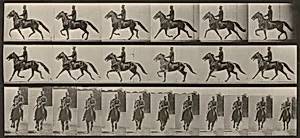
Plate Number 593. "Pronto" pacing, saddled
Medium
collotype
Dimensions
image: 18.9 × 40.8 cm (7 7/16 × 16 1/16 in.) sheet: 47.63 × 60.33 cm (18 3/4 × 23 3/4 in.)
Classification
Photograph
Department
CPH
Museum
National Gallery of Art, Washington, D.C.
Credit
Corcoran Collection (Museum Purchase, 1887)
Accession Number
2014.79.561
Rights
Public Domain
Art Historical Context
Step into the groundbreaking world of motion captured in stillness with *Plate Number 593. "Pronto" pacing saddled* by Eadweard Muy, created in 1887. This collotype print from the National Gallery of Art Corcoran Collection depicts saddled horse named "Pron" in mid-pace, frozen across multiple sequential frames. Muybridge, a pioneering photographer, transformed visual art by using high-speed cameras to dissect animal movement, proving that horses briefly lift all four hooves off the ground—a fact invisible to the naked eye. Part of Muybridge's monumental *Animal Locomotion* series, comprising 781 plates, this image exemplifies his scientific rigor and artistic innovation. Commissioned initially by railroad magnate Leland Stanford to settle a bet, Muybridge's work evolved into a comprehensive study of gait and anatomy, influencing fields from zoology to early film. The wide panoramic format (image: 18.9 × 40.8 cm; sheet: 47.63 × 60.33 cm) allows viewers to trace the fluid progression of Pronto's stride, bridging photography's documentary roots with emerging modernist experiments in time and space. Printed via collotype—a precise photomechanical process that faithfully reproduced fine details—this plate made Muybridge's discoveries accessible to scholars and artists alike. Today, it reminds us how one photographer's curiosity galloped ahead, laying the groundwork for cinema and dynamic art. (198 words)
About the Artist
Eadweard Muybridge · 1830–1904
Eadweard Muybridge (1830-1904) was an English-American photographer who revolutionized the understanding of motion through his pioneering chronophotographic studies. Born Edward James Muggeridge in Kingston upon Thames, England, he emigrated to America and became famous first for his dramatic landscape photographs of Yosemite Valley, then for his groundbreaking motion studies that proved horses li...