
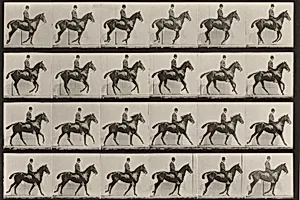
Plate Number 616. "Daisy" cantering, saddled
Medium
collotype
Dimensions
image: 22.4 × 33.4 cm (8 13/16 × 13 1/8 in.) sheet: 47.63 × 60.33 cm (18 3/4 × 23 3/4 in.)
Classification
Photograph
Department
CPH
Museum
National Gallery of Art, Washington, D.C.
Credit
Corcoran Collection (Museum Purchase, 1887)
Accession Number
2014.79.583
Rights
Public Domain
Art Historical Context
Step into the groundbreaking world of motion photography with *Plate Number 616. "Daisy" cantering, saddled by Eadweard Muybridge, created in 1887. This collotype print is part of Muybridge's monumental *Animal Locomotion* series a 781-plate study that captured animals and humans in sequential motion using multiple cameras triggered by the subject's movement. Commissioned after his famous 1870s horse-gallop experiments debunking the myth that all four hooves leave the ground simultaneously, this image shows the horse Daisy mid-canter, saddled and dynamic, revealing the fluid mechanics of equine gait. Muybridge, a British-American photographer and innovator, pioneered stop-motion techniques with battery-powered shutters and electrified tripwires, producing the first systematic visual analysis of locomotion. The collotype medium—a finely detailed printing process—allowed precise reproduction of these high-speed exposures (up to 1/1000th of a second), making scientific imagery accessible to artists and scholars. Acquired by the Corcoran Gallery in 1887 and now in the National Gallery of Art's Corcoran Collection, it exemplifies photography's shift from static portraiture to scientific artistry. This plate not only advanced zoology and anatomy studies—influencing painters like Thomas Eakins—but also laid groundwork for motion pictures, captivating 19th-century audiences with "reality in motion." Gaze at Daisy's poised stride and feel the thrill of discovery!
About the Artist
Eadweard Muybridge · 1830–1904
Eadweard Muybridge (1830-1904) was an English-American photographer who revolutionized the understanding of motion through his pioneering chronophotographic studies. Born Edward James Muggeridge in Kingston upon Thames, England, he emigrated to America and became famous first for his dramatic landscape photographs of Yosemite Valley, then for his groundbreaking motion studies that proved horses li...