
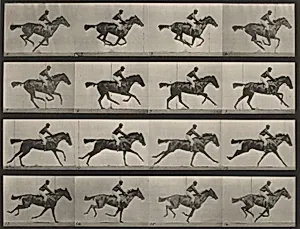
Plate Number 626. "Annie G." galloping
Medium
collotype
Dimensions
image: 23.5 × 30.8 cm (9 1/4 × 12 1/8 in.) sheet: 47.63 × 60.33 cm (18 3/4 × 23 3/4 in.)
Classification
Photograph
Department
CPH
Museum
National Gallery of Art, Washington, D.C.
Credit
Corcoran Collection (Museum Purchase, 1887)
Accession Number
2014.79.593
Rights
Public Domain
Art Historical Context
Step into the groundbreaking world of motion captured in stillness with *Plate Number 626.Annie G." galloping by Eadweard Muybridge, created in 1887. This collotype print is part of Muybridge's monumental *Animal Locomotion* series a pioneering study of movement featuring over 780 plates. Muybridge, a British-American photographer, used a battery of 24 cameras triggered sequentially by the subject's motion to dissect the gallop of the horse "Annie G.," revealing the elegant rhythm of her stride. The collotype medium—a precise photomechanical process—allowed for exquisite reproductions of these sequential images on a large sheet (47.63 × 60.33 cm), preserving fine details from the original 23.5 × 30.8 cm photographs. Muybridge's chronophotography not only settled a famous 19th-century debate about whether all four horse hooves ever leave the ground (they do!), but also laid the foundation for cinema by proving motion could be analyzed and reconstructed frame by frame. Acquired through the Corcoran Collection (Museum Purchase, 1887) and now housed in the National Gallery of Art's Department of Photographs, this work invites us to marvel at the blend of science and art, transforming a simple gallop into a timeless revelation of life's dynamic poetry.
About the Artist
Eadweard Muybridge · 1830–1904
Eadweard Muybridge (1830-1904) was an English-American photographer who revolutionized the understanding of motion through his pioneering chronophotographic studies. Born Edward James Muggeridge in Kingston upon Thames, England, he emigrated to America and became famous first for his dramatic landscape photographs of Yosemite Valley, then for his groundbreaking motion studies that proved horses li...