
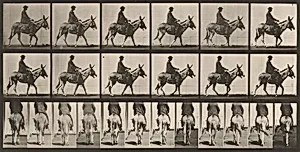
Plate Number 667. Ass; walking, saddle; a boy riding, Zoo
Medium
collotype
Dimensions
image: 19.3 × 38.1 cm (7 5/8 × 15 in.) sheet: 47.7 × 60.5 cm (18 3/4 × 23 13/16 in.)
Classification
Photograph
Department
CPH
Museum
National Gallery of Art, Washington, D.C.
Credit
Pepita Milmore Memorial Fund
Accession Number
2019.140.1
Rights
Public Domain
Art Historical Context
Eadweard Muybridge's *Plate Number 667. Ass; walking, saddle; a boy riding, Zoo* (1887) captures a pivotal moment in the history of photography and motion studies. Part of Muybridge's groundbreaking *Animal Locomotion* series, this collotype print freezes a donkey mid-stride at the Philadelphia Zoo, with a young boy astride a saddle. Muybridge, a British-American photographer, revolutionized visual arts through his chronophotographic experiments, using multiple cameras triggered in rapid sequence to dissect animal and human movement. The image exemplifies Muybridge's scientific precision, influenced by his earlier work debunking myths about horse gaits for Leland Stanford. Here, the donkey's walking gait—its legs in coordinated suspension—reveals the subtle biomechanics invisible to the naked eye, blending art with emerging fields like zoology and physiology. Produced via collotype, a photomechanical process yielding richly detailed reproductions, the plate measures 19.3 × 38.1 cm, allowing viewers to scrutinize every muscle twitch. Displayed at the National Gallery of Art through the Pepita Milmore Memorial Fund, this work underscores photography's shift from static portraiture to dynamic analysis, paving the way for motion pictures. Imagine the wonder of 1880s audiences poring over these plates—today, they invite us to marvel at motion's poetry.
About the Artist
Eadweard Muybridge · 1830–1904
Eadweard Muybridge (1830-1904) was an English-American photographer who revolutionized the understanding of motion through his pioneering chronophotographic studies. Born Edward James Muggeridge in Kingston upon Thames, England, he emigrated to America and became famous first for his dramatic landscape photographs of Yosemite Valley, then for his groundbreaking motion studies that proved horses li...