
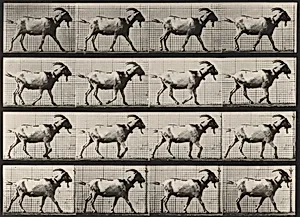
Plate Number 676. Goat; walking
Medium
collotype
Dimensions
image: 23.1 × 31.9 cm (9 1/8 × 12 9/16 in.) sheet: 46.1 × 60.1 cm (18 1/8 × 23 11/16 in.)
Classification
Photograph
Department
CPH
Museum
National Gallery of Art, Washington, D.C.
Credit
Pepita Milmore Memorial Fund
Accession Number
2019.150.2
Rights
Public Domain
Art Historical Context
Step into the pioneering world of motion photography with *Plate Number 676.; walking* by Eadweard Muybridge, created in 1887. This collotype print captures a goat mid-stride in a sequence of 12 frames, revealing the subtle mechanics of animal movement that the naked eye misses. Part of Muybridge's monumental *Animal Locomotion* seriescomprising 781 plates—Muybridge employed multiple cameras triggered in rapid succession, freezing moments to dissect gait and anatomy with scientific precision. Muybridge, a British-American photographer, revolutionized visual arts in the late 19th century through his chronophotographic experiments. Initially sparked by a bet on whether horses truly lift all four hooves off the ground while galloping, his work expanded to humans and animals, influencing early cinema, biomechanics, and modern animation. The collotype medium, a photomechanical process, allowed for exquisite detail in large-scale reproductions (sheet: 46.1 × 60.1 cm), making complex studies accessible beyond the lab. Today, housed in the National Gallery of Art's Department of Photographs (acquired via the Pepita Milmore Memorial Fund), this plate underscores Muybridge's blend of art and science. It invites us to marvel at everyday motion, bridging Victorian curiosity with our digital age's slow-motion reveries. (198 words)
About the Artist
Eadweard Muybridge · 1830–1904
Eadweard Muybridge (1830-1904) was an English-American photographer who revolutionized the understanding of motion through his pioneering chronophotographic studies. Born Edward James Muggeridge in Kingston upon Thames, England, he emigrated to America and became famous first for his dramatic landscape photographs of Yosemite Valley, then for his groundbreaking motion studies that proved horses li...