
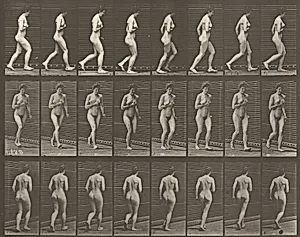
Plate Number 70. Running
Medium
collotype
Dimensions
image: 24 × 30.2 cm (9 7/16 × 11 7/8 in.) sheet: 47.9 × 60.4 cm (18 7/8 × 23 3/4 in.)
Classification
Photograph
Department
CPH
Museum
National Gallery of Art, Washington, D.C.
Credit
Corcoran Collection (Museum Purchase, 1887)
Accession Number
2014.79.121
Rights
Public Domain
Art Historical Context
Eadweard Muybridge *Plate Number 70.* (1887) is a captivating collotype print from his groundbreaking *Animal Locomotion* series, capturing the fluid motion of a nude male figure in mid-stride. Produced as part of a monumental 781-plate study funded by the University of Pennsylvania this image exemplifies Muybridge's pioneering chronophotography—using a battery of up to 24 cameras triggered sequentially by the subject's movement across a marked. The result? A scientific yet artistic dissection of human gait, debunking centuries-old artistic misconceptions about how bodies truly run. Printed via collotype, a photomechanical process that faithfully reproduced the original glass-plate negatives with stunning detail and tonal range, this 24 × 30.2 cm image (on a larger 47.9 × 60.4 cm sheet) allowed widespread dissemination of Muybridge's findings. Acquired by the Corcoran Gallery in 1887 and now in the National Gallery of Art's Corcoran Collection, it bridges photography, science, and art, influencing everyone from Thomas Edison to Marcel Duchamp. Fun fact: Muybridge's motion experiments began with proving a trotting horse's gait for Leland Stanford, evolving into this human-focused opus. Step into the gallery and witness the birth of cinema in a single frame!
About the Artist
Eadweard Muybridge · 1830–1904
Eadweard Muybridge (1830-1904) was an English-American photographer who revolutionized the understanding of motion through his pioneering chronophotographic studies. Born Edward James Muggeridge in Kingston upon Thames, England, he emigrated to America and became famous first for his dramatic landscape photographs of Yosemite Valley, then for his groundbreaking motion studies that proved horses li...