
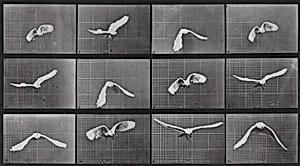
Plate Number 762. Cockatoo flying
Medium
collotype
Dimensions
image: 19.69 × 36.2 cm (7 3/4 × 14 1/4 in.) sheet: 48.26 × 60.96 cm (19 × 24 in.)
Classification
Photograph
Department
CPH
Museum
National Gallery of Art, Washington, D.C.
Credit
Corcoran Collection (Museum Purchase, 1887)
Accession Number
2014.79.687
Rights
Public Domain
Art Historical Context
Behold *Plate Number 762. Cockatoo Flying* (1887), a captivating collotype print by pioneering photographer Eadweard Muybridge. Part of his groundbreaking *Animal Locomotion* series, this image captures a cockatoo in mid-flight across sequential frames, revealing the elegant rhythm of its wings and body in motion. Muybridge, a British-American innovator, produced over 20,000 such studies between 1884 and 1887 at the University of Pennsylvania, using banks of cameras triggered by the subject to "stop" movement—a feat that shattered 19th-century illusions about animal anatomy in action. The collotype medium was revolutionary for its time, a photomechanical process yielding richly detailed, continuous-tone reproductions from Muybridge's original glass negatives. Measuring 19.69 × 36.2 cm (image) on a larger 48.26 × 60.96 cm sheet, this plate exemplifies how photography bridged art and science, influencing early cinema pioneers like Thomas Edison and Eadweard’s own zoopraxiscope projections. Acquired through the Corcoran Collection (Museum Purchase, 1887) and now housed in the National Gallery of Art’s CPH Department, it invites visitors to marvel at the cockatoo’s graceful soar, a testament to Muybridge’s quest to visualize life's hidden dynamics.
About the Artist
Eadweard Muybridge · 1830–1904
Eadweard Muybridge (1830-1904) was an English-American photographer who revolutionized the understanding of motion through his pioneering chronophotographic studies. Born Edward James Muggeridge in Kingston upon Thames, England, he emigrated to America and became famous first for his dramatic landscape photographs of Yosemite Valley, then for his groundbreaking motion studies that proved horses li...