
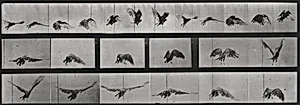
Plate Number 768. Vulture flying
Medium
collotype
Dimensions
image: 15.88 × 45.72 cm (6 1/4 × 18 in.) sheet: 47.63 × 60.33 cm (18 3/4 × 23 3/4 in.)
Classification
Photograph
Department
CPH
Museum
National Gallery of Art, Washington, D.C.
Credit
Corcoran Collection (Museum Purchase, 1887)
Accession Number
2014.79.692
Rights
Public Domain
Art Historical Context
Behold *Plate Number 768. Vulture Flying*, a captivating collotype print from Eadard Muybridge's groundbreaking *Animal Locomotion* series 1887. Muybridge, a pioneering photographer often hailed as a father of motion pictures, captured this dynamic sequence of a vulture in mid-flight using his innovative battery of up to 24 cameras triggered by the animal's movement across a marked grid. Produced as part of a monumental 781-plate study funded by the University of Pennsylvania, this image exemplifies his scientific quest to dissect and reveal the hidden mechanics of animal motion, challenging long-held artistic conventions of how birds soar. The collotype medium—a precise photomechanical process—allowed Muybridge to reproduce his original glass-plate negatives with exceptional fidelity, preserving every feather's flutter and wingbeat in stunning detail across the sheet's generous 47.63 × 60.33 cm format. Acquired by the Corcoran Gallery in 1887 and now in the National Gallery of Art's collection, this work bridges art and science, influencing everyone from zoologists to filmmakers like Eadweard Muybridge's contemporaries. Today, it invites us to marvel at nature's elegance frozen in time, reminding visitors of photography's power to transform perception in the late 19th century. (198 words)
About the Artist
Eadweard Muybridge · 1830–1904
Eadweard Muybridge (1830-1904) was an English-American photographer who revolutionized the understanding of motion through his pioneering chronophotographic studies. Born Edward James Muggeridge in Kingston upon Thames, England, he emigrated to America and became famous first for his dramatic landscape photographs of Yosemite Valley, then for his groundbreaking motion studies that proved horses li...