
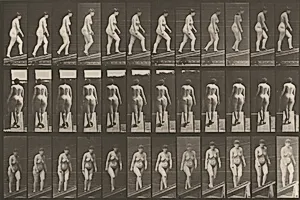
Plate Number 86. Ascending an incline
Medium
collotype
Dimensions
image: 21.7 × 32.7 cm (8 9/16 × 12 7/8 in.) sheet: 47.75 × 60.35 cm (18 13/16 × 23 3/4 in.)
Classification
Photograph
Department
CPH
Museum
National Gallery of Art, Washington, D.C.
Credit
Corcoran Collection (Museum Purchase, 1887)
Accession Number
2014.79.137
Rights
Public Domain
Art Historical Context
Behold *Plate Number 86. Ascending an Incline* by pioneering photographer Eadweard Muybridge, created in 1887. This collotype print, measuring 21.7 × 32.7 cm in its image area, captures a human figure dynamically scaling a slope, frozen in sequential motion—a hallmark of Muybridge's groundbreaking *Animal Locomotion* series. Muybridge, a British-American innovator, revolutionized visual perception in the late 19th century by using banks of cameras triggered in rapid succession to dissect movement. Commissioned by Leland Stanford and refined over years, his work settled age-old debates on animal gait and laid foundational stones for motion pictures. Acquired by the Corcoran Gallery in 1887 (now part of the National Gallery of Art's Corcoran Collection), this plate exemplifies how photography bridged art and science, influencing filmmakers like the Lumière brothers. The collotype medium, a photomechanical process yielding exquisite tonal detail, allowed mass reproduction of these studies for scholars and artists alike. Gaze upon it and marvel at the elegant stride midway up the incline— a testament to Muybridge's genius in revealing the poetry hidden in motion.
About the Artist
Eadweard Muybridge · 1830–1904
Eadweard Muybridge (1830-1904) was an English-American photographer who revolutionized the understanding of motion through his pioneering chronophotographic studies. Born Edward James Muggeridge in Kingston upon Thames, England, he emigrated to America and became famous first for his dramatic landscape photographs of Yosemite Valley, then for his groundbreaking motion studies that proved horses li...