
Plate (one of a pair)
probably 19th century
Medium
Hard-paste porcelain
Dimensions
Diameter: 9 1/2 in. (24.1 cm)
Classification
Ceramics-Porcelain
Culture
German, Meissen
Department
European Sculpture and Decorative Arts
Museum
Metropolitan Museum of Art, New York, NY
Credit
Gift of Alfred Duane Pell, 1902
Accession Number
02.6.131
Rights
Public Domain
Tags
Art Historical Context
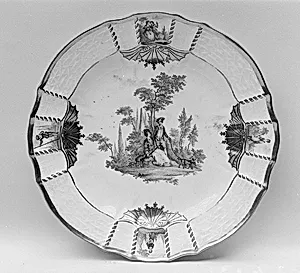
This elegant plate, one of a pair produced by the renowned Meissen Manufactory Germany, exemplifies 19th-century European porcelain. Crafted from hard-paste porcelain—a technically advanced material first perfected by Meissen in 1710—this 9½-inch (24.1 cm) diameter boasts the translucent, durable quality that rivaled prized Chinese imports. Donated to the Metropolitan Museum of Art in1902 by Alfred Duane, it resides in the Sculpture and Decorative Arts, highlighting Meissen's enduring legacy in luxury ceramics. Meissen, based in Saxony, revolutionized European tableware and decorative objects by mastering hard-paste porcelain, which allowed for intricate modeling and vibrant overglaze enameling. Though dating to the 19th century, this plate reflects the manufactory's rococo traditions, evolving into more narrative scenes amid the era's neoclassical and romantic tastes. Its surface likely features lively depictions of men, women, and dogs, evoking aristocratic leisure or pastoral vignettes common in Meissen designs—symbols of refinement and status for elite dining. As a functional yet sculptural object, the plate underscores porcelain's cultural prestige in 19th-century Europe, bridging utility and high art. Visitors will appreciate its delicate craftsmanship, a testament to Meissen's two-century dominance in the field.
About the Artist
Meissen Manufactory · 1710–present
The Meissen Manufactory, established on June 6, 1710, by Augustus the Strong, Elector of Saxony and King of Poland, marked the dawn of true hard-paste porcelain production in Europe. Nestled at Albrechtsburg Castle in Meissen near Dresden, the Royal Polish and Electoral Saxon Porcelain Manufactory arose from alchemical experiments begun in 1708 by physicist Ehrenfried Walther von Tschirnhaus and p...