
Plate (one of a pair)
Unknown Artist
mid-18th century
Medium
Hard-paste porcelain
Dimensions
Overall: 1 1/16 × 9 in. (2.7 × 22.9 cm)
Classification
Ceramics-Porcelain-Export
Culture
Chinese, for British or Scottish market
Department
European Sculpture and Decorative Arts
Museum
Metropolitan Museum of Art, New York, NY
Credit
Helena Woolworth McCann Collection, Purchase, Winfield Foundation Gift, 1962
Accession Number
62.125.1
Rights
Public Domain
Tags
Art Historical Context
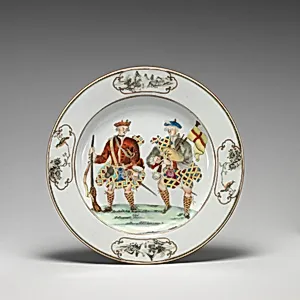
This elegant mid-18th-century plate, one of a pair crafted in hard-paste porcelain, exemplifies the artistry of Chinese export ceramics tailored for the British or Scottish. Measuring just over 9 inches in diameter, its delicate form features vibrant overglaze enamel decorations depicting men with bagpipes, flags, firearms, and musicians—likely a lively Scottish Highland procession or military band, a popular motif reflecting European tastes during the height of Sino-European trade. Hard-paste porcelain, a Chinese innovation perfected in the early 18th century, revolutionized global ceramics with its translucent durability and fine white body, far superior to European soft-paste imitations. Exported in vast quantities from Jingdezhen kilns, these pieces were hand-painted by skilled anonymous artisans using famille rose enamels, blending intricate Chinese techniques with Western subjects to appeal to affluent collectors. Such plates hold cultural significance as bridges between East and West, capturing the era's fascination with exotic goods amid rising colonial trade. Displayed in the Metropolitan Museum of Art's European Sculpture and Decorative Arts department (from the Helena Woolworth McCann Collection, 1962), they offer a window into 18th-century global exchange and the playful adaptation of Scottish identity in porcelain form.