
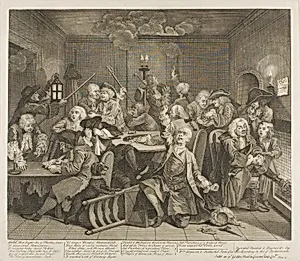
Plate Six, from A Rake's Progress
June 1735
Medium
Etching and engraving in black on ivory laid paper
Dimensions
Image: 31.5 × 38.6 cm (12 7/16 × 15 1/4 in.); Plate: 35.7 × 41 cm (14 1/16 × 16 3/16 in.); Sheet: 46.5 × 60.6 cm (18 5/16 × 23 7/8 in.)
Classification
etching
Department
Prints and Drawings
Museum
Art Institute of Chicago
Accession Number
80814
Rights
Public Domain
Art Historical Context
**Plate Six from *A Rake's Progress***, created by William Hogarth in 1735, is a pivotal scene from the artist's acclaimed satirical series chronicling the downfall of a young rake—Tom Rakewell—who squanders his inheritance on vice and folly. Hogarth, a master of 18th-century English satire, drew from contemporary London life to expose the perils of moral decay, blending sharp social commentary with dramatic narrative. This etching captures a moment of reckoning, likely depicting the protagonist's imprisonment amid debtors and despair, emblematic of the series' cautionary tale. Rendered in etching and engraving on ivory laid paper, the work showcases Hogarth's innovative printmaking prowess. Etching allowed fluid, expressive lines for chaotic compositions, while engraving added precise detail to satirical elements like caricatured figures and symbolic clutter. These techniques made high art accessible through affordable reproductions, revolutionizing how moral lessons reached the public beyond elite paintings. Housed in the Art Institute of Chicago's Prints and Drawings department, this 31.5 × 38.6 cm image endures as a cultural touchstone, influencing later artists from William Blake to modern graphic novels. Hogarth's vivid storytelling reminds us of timeless human frailties, inviting visitors to reflect on ambition's double edge.
About the Artist
William Hogarth · 1697–1764
William Hogarth (1697-1764) was an English painter, printmaker, and pictorial satirist who became the first great English-born artist to attract admiration abroad. Born into poverty in London, the son of a failed schoolmaster who was imprisoned for debt, Hogarth's early experiences with the harsh realities of 18th-century urban life profoundly shaped his artistic vision. After apprenticing with si...