
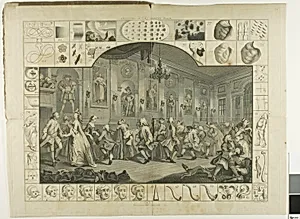
Plate Two, from The Analysis of Beauty
1756/61
Medium
Etching and engraving in black on cream laid paper (now split in two, with the left side laid down on back book cover and the right side in two parts)
Dimensions
Image: 36.5 × 49.5 cm (14 3/8 × 19 1/2 in.); Plate: 41.5 × 54.5 cm (16 3/8 × 21 1/2 in.); Sheet: 43.5 × 56.5 cm (17 3/16 × 22 1/4 in.)
Classification
etching
Department
Prints and Drawings
Museum
Art Institute of Chicago
Accession Number
152305
Rights
Public Domain
Art Historical Context
William Hogarth's *Plate Two, from The Analysis of Beauty* (1756/61) is a captivating etching and engraving that exemplifies the artist's bold theories on aesthetics. Hogarth, a pioneering 18th-century Englishist and engraver, self-published his treatise *The Analysis of* in 1753 to challenge rigid academic rules, championing the "serpentine line" as the essence of graceful beauty. This plate visually demonstrates his ideas, contrasting stiff, angular "Gothic" forms with flowing, elegant curves in figures dancing and posing amid musicians and spectators. Masterfully executed in black ink on cream laid paper, the medium highlights Hogarth's technical prowess in etching and engraving, techniques he controlled personally to ensure satirical bite and wide accessibility through affordable prints. Measuring nearly 37 x 50 cm, the image buzzes with Rococo energy—playful yet instructive—critiquing artistic conventions while celebrating natural movement. Today, housed in the Art Institute of Chicago's Prints and Drawings department, this example bears the marks of time: split into sections, with the left side mounted on a book cover. It remains a testament to Hogarth's influence on British art, blending education, humor, and innovation for audiences eager to decode beauty's secrets.
About the Artist
William Hogarth · 1697–1764
William Hogarth (1697-1764) was an English painter, printmaker, and pictorial satirist who became the first great English-born artist to attract admiration abroad. Born into poverty in London, the son of a failed schoolmaster who was imprisoned for debt, Hogarth's early experiences with the harsh realities of 18th-century urban life profoundly shaped his artistic vision. After apprenticing with si...