
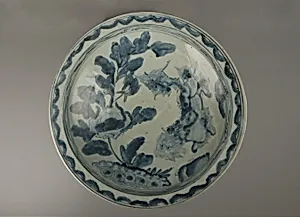
Plate with Lion Design
Unknown Artist
Medium
Porcelain stoneware with underglaze blue (Hizen ware, early Imari type)
Dimensions
H. 5 1/2 in. (14 cm); Diam. of rim: 17 in. (43.2 cm); Diam. of foot: 5 1/2 in. (14 cm)
Classification
Ceramics
Culture & Period
Japan · Edo period (1615–1868)
Department
Asian Art
Museum
Metropolitan Museum of Art, New York, NY
Credit
The Harry G. C. Packard Collection of Asian Art, Gift of Harry G. C. Packard, and Purchase, Fletcher, Rogers, Harris Brisbane Dick, and Louis V. Bell Funds, Joseph Pulitzer Bequest, and The Annenberg Fund Inc. Gift, 1975
Accession Number
1975.268.471
Rights
Public Domain
Tags
Art Historical Context
This stunning *Plate with Lion Design*, crafted in porcelain stoneware with underglaze blue, exemplifies early Imari-type Hizen ware from Japan's Edo period (16151868). Produced in the Hizen region (modern-day Saga Prefecture), particularly around Arita kilns, these ceramics marked a pivotal advancement in Japanese porcelain production. Influenced by Chinese techniques introduced via trade, Hizen potters mastered durable stoneware bodies fired at high temperatures, then decorated with cobalt-blue underglaze before glazing. The result: vibrant, impermeable wares prized for both domestic use and export to Europe, where "Imari" became synonymous with luxury porcelain. Measuring an impressive 17 inches across the rim, this shallow plate features dynamic lions amid insects, rendered in bold blue motifs against a white ground—a hallmark of early Imari's restrained yet elegant aesthetic. Lions, rare in native Japanese iconography, likely draw from Chinese lion-dog guardians (shishi or komainu), symbolizing power and protection. The underglaze method ensured colors remained vivid through centuries, highlighting the artisans' technical prowess. Part of The Harry G. C. Packard Collection at The Metropolitan Museum of Art, this piece invites visitors to appreciate Edo Japan's fusion of innovation and tradition, bridging East-West artistic exchange.