
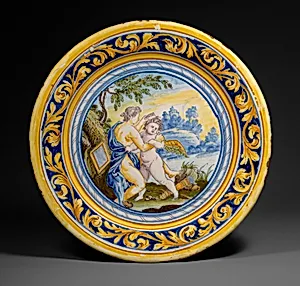
Plate with Venus combing Cupid's hair
mid-17th century
Medium
Faience (tin-glazed earthenware)
Dimensions
Diameter: 10 in. (25.4 cm)
Classification
Ceramics-Pottery
Culture
French, Nevers
Department
European Sculpture and Decorative Arts
Museum
Metropolitan Museum of Art, New York, NY
Credit
Gift of J. Pierpont Morgan, 1917
Accession Number
17.190.1812
Rights
Public Domain
Tags
Art Historical Context
This mid-17th-century faience plate from Nevers, France, captures a tender mythological moment: Venus gently combing her son Cupid’s hair, his bow and arrow resting nearby. Created in tin-glazed earthenware, the work reflects the period’s fascination with classical themes drawn from ancient Roman and Renaissance sources. Odoardo Fialetti, the Italian artist credited with the design, brought a graceful, painterly sensibility to the composition, which Nevers potters adapted for ceramic surfaces. Faience production in Nevers flourished under French patronage, allowing artisans to achieve vibrant colors and intricate details on affordable earthenware that mimicked costly imported porcelain. The tin glaze provided a smooth white ground ideal for narrative scenes, making such plates popular in well-appointed households for both display and daily use. Now part of the Metropolitan Museum’s European decorative arts collection through J. Pierpont Morgan’s 1917 gift, the plate exemplifies how 17th-century ceramics bridged fine art and domestic life, bringing stories of love and mythology into everyday surroundings.
About the Artist
Odoardo Fialetti · 1573–1638
Comment on works: Painter; Etcher