
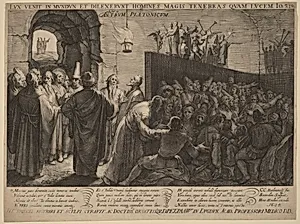
Plato's Cave
Medium
engraving on laid paper
Dimensions
sheet (trimmed to plate mark): 33.7 x 45 cm (13 1/4 x 17 11/16 in.)
Classification
Department
CG-E
Museum
National Gallery of Art, Washington, D.C.
Credit
Ailsa Mellon Bruce Fund
Accession Number
1983.61.1
Rights
Public Domain
Art Historical Context
Created in 1604, *Plato’s Cave* captures the famous allegory from Plato’s *Republic*, in which prisoners chained in a cave mistake flickering shadows for reality. Jan Pietersz Saenredam, a leading Dutch engraver, translated a design by Cornelis Cornelisz van Haarlem into this large print, allowing viewers across Europe to contemplate the philosopher’s ideas about perception, knowledge, and enlightenment. The choice of engraving on laid paper was ideal for the subject. The medium’s capacity for fine lines and subtle tonal gradations lets Saenredam render dramatic contrasts between light and shadow, heightening the illusion of flickering firelight on the cave walls. Such reproductive prints played a vital role in the early seventeenth century, spreading complex intellectual themes beyond the walls of private collections. Housed in the National Gallery of Art, this impression reflects the Dutch Republic’s lively exchange between classical learning and innovative printmaking. Through precise technique and thoughtful composition, the work invites today’s visitors to consider how images shape our understanding of truth—just as Plato intended more than two thousand years ago.