
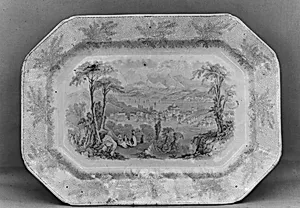
Platter
ca. 1844–ca. 1846
Medium
Earthenware, transfer-printed
Dimensions
12 5/8 x 17 1/4 in. (32.1 x 43.8 cm)
Classification
Platter
Culture
British (American market)
Department
The American Wing
Museum
Metropolitan Museum of Art, New York, NY
Credit
Bequest of Mary Mandeville Johnston, from the collection of Mr. and Mrs. Edward W. S. Johnston, 1914
Accession Number
14.102.257
Rights
Public Domain
Tags
Art Historical Context
This elegant platter, crafted by the British pottery firm William Ridgway, Son & Co. around 1844–1846, exemplifies the height of Staffordshire earthenware production for the American market. Measuring 12⅝ × 17¼ inches, it features transfer-printed landscapes—a technique that allowed intricate, colorful designs to be mass-produced by printing patterns onto tissue paper, transferring them to unfired clay, and then glazing. This innovation made high-quality decorated ceramics affordable for middle-class American households during the antebellum era. Produced in England but tailored for U.S. consumers, the platter reflects the booming transatlantic trade in ceramics that shaped American dining and decorative arts. Staffordshire potters like Ridgway dominated this market, exporting millions of pieces with scenic views that evoked both British countryside idylls and idealized American landscapes, fostering a sense of cultural exchange. Displayed in The Metropolitan Museum of Art's American Wing, it highlights how everyday objects became canvases for artistic expression. A bequest from Mary Mandeville Johnston in 1914, this platter offers a tangible link to 19th-century domestic life, where such wares graced tables during family gatherings and festive meals, blending utility with subtle artistry.