
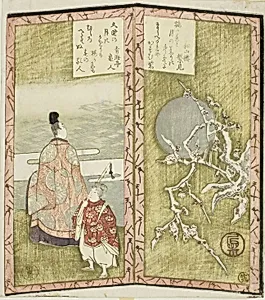
Plum blossoms and poet, from an untitled hexaptych depicting a pair of folding screens
c. 1825
Medium
Color woodblock print; sheet from shikishiban hexaptych, surimono
Dimensions
21.1 × 18.8 cm (8 5/16 × 7 7/16 in.)
Classification
woodblock print
Department
Arts of Asia
Museum
Art Institute of Chicago
Accession Number
81330
Rights
Public Domain
Art Historical Context
This delicate color woodblock print by Ryuryukyo Shinsai, created around 1825, forms one sheet of a hexaptych designed to evoke a pair of folding screens. Measuring just over eight inches square, the surimono—a privately commissioned print often produced for poetry circles—combines refined imagery with literary elegance. Shinsai’s work captures the quiet beauty of plum blossoms alongside a contemplative poet, inviting viewers to appreciate the seasonal symbolism of renewal and resilience that these flowers hold in Japanese culture. Surimono prints like this one were prized for their luxurious production, frequently incorporating embossing, metallic pigments, and poems composed by the artist’s contemporaries. As part of a larger set, this sheet would have contributed to an immersive scene when displayed together, mimicking the experience of viewing actual painted screens in a traditional interior. The compact shikishiban format made such works ideal for personal appreciation or gifting during the New Year season. Today housed in the Art Institute of Chicago’s Arts of Asia collection, the print exemplifies the refined tastes of early nineteenth-century Japanese urban society. Its intimate scale and poetic subject matter continue to offer modern audiences a glimpse into the harmonious blend of art, literature, and nature that defined surimono traditions.