
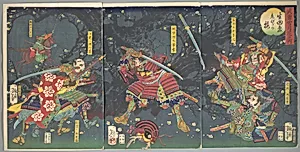
武勇雪月花之内 ゑびらの梅|Plum Blossoms in the Forrest of Ikuta, from the series Bravery-Beauty of the four seasons (Buyū setsugekka no uchi-Ikuta no mori, Ebira no ume)
Medium
Triptych of woodblock prints; ink and color on paper
Dimensions
Overall (a): 14 3/4 x 10 in. (37.5 x 25.4 cm) Overall (b): 14 9/16 x 10 in. (37 x 25.4 cm) Overall (c): 14 9/16 x 10 in. (37 x 25.4 cm)
Classification
Prints
Culture & Period
Japan · Edo period (1615–1868)
Department
Asian Art
Museum
Metropolitan Museum of Art, New York, NY
Credit
Purchase, Friends of Asian Art Gifts, 2005
Accession Number
2005.348a–c
Tags
Art Historical Context
In the waning years of Japan's Edo period (1615–1868), ukiyo-e artist Tsoka Yoshitoshi created *Plum Blossoms in the Forest of Ikuta*, a striking triptych from his series *Bravery-Beauty of the Four Seasons (Buyū setsuge no uchi). Dated 1867, this woodblock print in ink and color on paper about 14¾ x 30 inches when assembled, capturing a dynamic fusion of martial valor and natural poetry. The title evokes the famed Ikuta Forest, a storied site from classical tales like *The Tale of the Heike*, where epic clashes unfolded amid seasonal splendor—here, delicate plum blossoms symbolizing resilienc...
About the Artist
Tsukioka Yoshitoshi · 1839–1892
Tsukioka Yoshitoshi was born on April 30, 1839, in the Shimbashi district of Edo, the city that would become Tokyo. At the age of eleven he was apprenticed to Utagawa Kuniyoshi, one of the great masters of the Japanese woodblock print, who gave the boy the artist name 'Yoshitoshi' as a mark of lineage within the Utagawa School. From Kuniyoshi, Yoshitoshi absorbed the full tradition of ukiyo-e — th...