
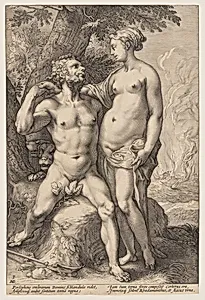
Pluto and Proserpina, from Three Paired Gods and Goddesses
c. 1594
Medium
Engraving on ivory laid paper
Dimensions
Sheet (trimmed): 32.2 × 21.5 cm (12 11/16 × 8 1/2 in.)
Classification
engraving
Department
Prints and Drawings
Museum
Art Institute of Chicago
Accession Number
268255
Rights
Public Domain
Art Historical Context
In the late 16th century, Dutch engraver Jan Saenam captured the dramatic myth of Pluto and Proserpina in this exquisite engraving, part of his series *Three Paired Gods and Goddesses* (c. 1594). Drawing from classical Roman mythology, the image depicts Pluto, god of the underworld, seizing the beautiful Proserpina—daughter of Ceres—in a moment of abduction that explains the seasons: her time below ground brings winter, her return above heralds spring. Saenredam's work reflects the era's fascination with ancient tales, revived during the Renaissance, blending Northern European precision with Mannerist elegance. Crafted as an engraving on ivory laid paper (sheet trimmed to 32.2 × 21.5 cm), this print showcases Saenredam's mastery of the intaglio technique. He incised fine lines into a copper plate, creating intricate textures and subtle tonal gradations when inked and pressed onto the creamy, durable paper. Such engravings were prized for their reproducibility, allowing myths to reach collectors across Europe, and highlight the Haarlem school's innovative printmaking during the Dutch Republic's cultural flowering. Housed in the Art Institute of Chicago's Prints and Drawings Department, this piece exemplifies how engravings democratized high art, bridging elite patronage and public appreciation. Visitors will admire its delicate details—flowing drapery, expressive gestures—that evoke both passion and pathos in a compact, timeless format.
About the Artist
Jan Saenredam · 1565–1607
Jan Pieterszoon Saenredam (c. 1565–1607) emerged from humble beginnings in the Dutch village of Assendelft, where he was orphaned young and raised by his uncle, the local bailiff Pieter de Jongh. Initially destined for basket weaving or farm work, Saenredam's precocious talent for embellishing texts with intricate designs caught attention, leading to an apprenticeship in cartography. By 1589, at a...