
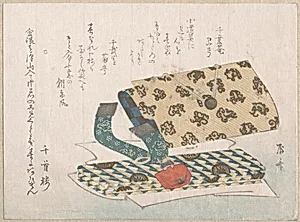
Pocketbook with Its Fittings
19th century
Medium
Part of an album of woodblock prints (surimono); ink and color on paper
Dimensions
5 3/8 x 7 1/4 in. (13.7 x 18.4 cm)
Classification
Prints
Culture
Japan
Department
Asian Art
Museum
Metropolitan Museum of Art, New York, NY
Credit
H. O. Havemeyer Collection, Bequest of Mrs. H. O. Havemeyer, 1929
Accession Number
JP2301
Rights
Public Domain
Art Historical Context
**Pocketbook with Its Fittings by Ryūryūkyo Shinsai, a master of 19th-century Japanese wood printing, captures the exquisite craftsmanship of everyday luxury items from Edo-period Japan. Created as part of a *surimono* album privately commissioned format of ink and color on paper—this print measures just 5 3/8 x 7 1/4 inches, perfect for personal appreciation. Shinsai, in the late 18th and early 19th centuries, a finely detailed pocketbook (*inro*), complete with its ornate fittings like netsuke toggles and cords, showcasing the era's obsession with portable, lacquered accessories worn suspended from the sash. *Surimono* prints like this one were elite connoisseurship pieces, often produced for poetry societies or New Year's greetings, featuring superior techniques such as subtle gradations of color (*bokashi*), metallic pigments, and embossing for texture. Shinsai's ukiyo-e style blends realism with poetic elegance, highlighting the tactile allure of these objects that blended fashion, artistry, and functionality in samurai and merchant culture. Unlike mass-produced prints, *surimono* emphasized exclusivity and technical virtuosity. Housed in the Metropolitan Museum of Art's Asian Art Department from the H. O. Havemeyer Collection (1929), this work invites visitors to ponder Japan's harmonious fusion of utility and beauty, a hallmark of its artistic heritage.
About the Artist
Ryūryūkyo Shinsai · 1799–1823
Ryūryūkyo Shinsai (柳々居辰斎), active from 1799 to 1823, was a prominent Japanese ukiyo-e printmaker based in Edo (modern Tokyo), renowned for his mastery of surimono—luxurious, privately commissioned woodblock prints produced for elite poetry circles and New Year's celebrations. He began his training under Tawaraya Sōri before becoming a student of the legendary Katsushika Hokusai, from whom he recei...