
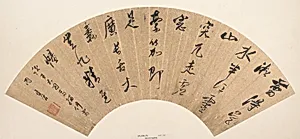
清 佚名 倣董其昌 行書題王霽宇繡佛齋圖七絕詩 扇頁|Poem
17th century or later
Medium
Folding fan mounted as an album leaf; ink on gold paper
Dimensions
6 11/16 x 20 1/2 in. (17.0 x 52.1 cm)
Classification
Calligraphy
Culture & Period
China · Qing dynasty (1644–1911)
Department
Asian Art
Museum
Metropolitan Museum of Art, New York, NY
Credit
John Stewart Kennedy Fund, 1913
Accession Number
13.100.72
Rights
Public Domain
Art Historical Context
This elegant folding fan, now mounted as an album leaf, showcases a seven-character quatrain written in fluid running script (xingshu). Although attributed to the renowned Ming master Dong Qichang, the work is by an anonymous Qing-dynasty artist who skillfully emulated his style. Created sometime after the 17th century during the Qing dynasty (1644–1911), the piece reflects the enduring reverence for Dong’s calligraphic innovations, which bridged classical traditions with expressive freedom. The choice of ink on shimmering gold paper enhances the fan’s luminous quality, a technique often favored for courtly or scholarly gifts. Folding fans themselves served both practical and artistic purposes in Chinese culture, allowing calligraphy and poetry to travel intimately between friends and collectors. Here, the poem references Wang Jiyu’s “Embroidered Buddha Studio” painting, linking visual art and literary expression in a single, portable format. As a fine example of Qing literati practice, this work illustrates how later artists continued to study and reinterpret earlier masters, preserving calligraphic heritage while adapting it for new audiences. Its presence in the Metropolitan Museum’s collection highlights the global appreciation for China’s rich tradition of brush-written poetry.
About the Artist
Dong Qichang · 1555–1636
Dong Qichang (1555–1636), born in Huating in present-day Shanghai's Songjiang region, emerged from a scholarly yet impoverished family as the son of a local school teacher. A precocious child, he passed the prefectural civil service examination at age twelve, securing entry to a government school, and later sat for the imperial exams, placing second at seventeen to his cousin due to inferior calli...