
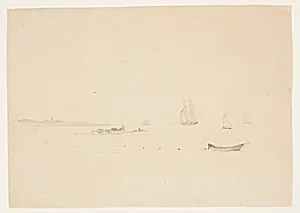
Point of Land with a Lighthouse
Medium
seascapes
Classification
seascapes
Department
Smithsonian Collection
Museum
Smithsonian American Art Museum
Credit
Gift of Charles Savage Homer, Jr.
Accession Number
1912-12-195
Rights
Public Domain
About this artwork
Research in Progress
Art Historical Context
Winslow Homer, one of America's foremost realist painters (18361910), captured the power of the sea inPoint of Land with a*, created around 1880. By this time, Homer had to his coastal studio in Prouts Neck, Maine, he immersed himself in depicting dramatic seascapes. This work exemplifies his shift from Civil War illustrations and genre scenes to monumental marine subjects, reflecting the untamed forces of nature that fascinated him. As a quintessential seascape, the painting showcases Homer's masterful handling of light, water, atmosphere, likely in oil or watercolor—media he perfected to convey movement and mood. The lighthouse, perched on a rugged point of land, symbolizes human resilience amid the ocean's vastness, a recurring theme in his oeuvre. Homer's realistic style, influenced by direct observation, rejected romantic idealization for unflinching truth, influencing generations of American artists. Now in the Smithsonian American Art Museum's collection, gifted by Homer's family member Charles Savage Homer, Jr., this piece invites visitors to ponder humanity's place in the natural world. Though research continues, it stands as a testament to Homer's enduring legacy in celebrating America's maritime heritage.