
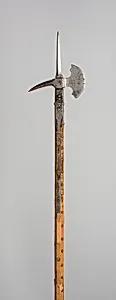
Poleaxe
1500
Medium
Steel, iron, wood (pine), brass, and velvet
Dimensions
H.: 224.8 cm (88 1/2 in.)
Classification
edged weapon-staff
Department
Applied Arts of Europe
Museum
Art Institute of Chicago
Accession Number
116324
Rights
Public Domain
Art Historical Context
This imposing Poleaxe, dated to around 1500 and created by an unknown European maker, exemplifies the sophisticated weaponry of the late Middle Ages. Standing nearly 225 cm tall, it unites steel and iron for the striking head, a sturdy pine-wood shaft, brass fittings, and velvet wrapping. Such staff weapons were essential tools for knights fighting in full plate armor, offering reach and versatility in both battlefield clashes and staged tournaments. The poleaxe combined an axe blade for cutting, a hammer or spike for crushing, and often a thrusting point, all mounted on a long shaft that kept the wielder at a safer distance. Decorative details like brass and velvet elevated it beyond mere utility, signaling the owner’s status and the era’s high craftsmanship in metal and wood. Though unsigned, the piece reflects the applied arts tradition in which function and beauty were inseparable. Today it resides in the Art Institute of Chicago’s Applied Arts of Europe collection, inviting visitors to appreciate how Renaissance-era artisans transformed instruments of war into objects of lasting cultural and artistic interest.
About the Artist
Unknown
The artist designated as "Unknown" in our virtual museum's collection exemplifies a poignant chapter in art history: creators whose identities have faded into obscurity despite the enduring power of their work. With only one known artwork attributed to them in our holdings, this figure represents countless anonymous hands that shaped visual culture across centuries. Museums worldwide, including th...