
Police Rattle
1940
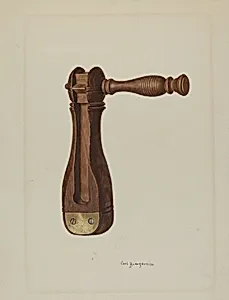
Medium
watercolor, graphite, and pen and ink on paper
Dimensions
overall: 38 x 29.1 cm (14 15/16 x 11 7/16 in.)
Classification
Index of American Design
Department
CG-W
Museum
National Gallery of Art, Washington, D.C.
Credit
Index of American Design
Accession Number
1943.8.13379
Rights
Public Domain
Art Historical Context
Step into the vivid world of American folk design with *Police Rattle*, a 1940 rendering by artist Carl Buergerniss. Created using watercolor, graphite, pen and ink on paper (measuring 38 x 29.1 cm), this work captures the intricate details of a traditional wooden noisemaker once used by law enforcement. Buergerniss's precise lines and subtle color washes bring to life the rattle's carved handle, geared mechanism, and pivoting wooden slats—elements that produced a distinctive clattering sound to alert crowds or summon aid. As part of the Index of American Design, a Federal Art Project under the Works Progress Administration (WPA) from the 1930s and 1940s, this piece exemplifies a monumental effort to document the nation's material culture. Over 18,000 watercolor renderings like this one preserved everyday objects, folk art, and crafts, ensuring their legacy amid rapid modernization. Housed in the National Gallery of Art's CG-W Department, it highlights how artists transformed historical artifacts into accessible, artistic records. The police rattle itself holds cultural charm: predating modern whistles, these 19th-century tools symbolized urban policing in early America, blending functionality with whimsical craftsmanship. Buergerniss's mixed-media technique—graphite for shading, ink for outlines, and watercolor for texture—demonstrates the Index's commitment to accuracy and beauty, inviting us to appreciate overlooked slices of history.
About the Artist
Carl Buergerniss · 1877–1956
**Carl Buergerniss** (1877–1956) was an American artist born in Philadelphia, Pennsylvania, who later made his home in Island Heights, New Jersey. He studied at the Pennsylvania Academy of the Fine Arts, a leading institution that shaped many American artists of his era, and exhibited there regularly from 1901 to 1930. While specific teachers are not documented in available sources, his training a...