
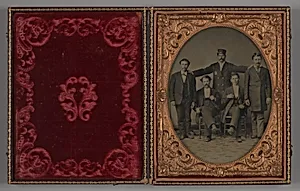
Policeman Posing with Four "Collared" Thugs
ca. 1875
Medium
Tintype
Dimensions
Image: 4 5/8 × 3 9/16 in. (11.7 × 9 cm) Plate: 5 7/16 × 4 1/16 in. (13.8 × 10.3 cm) Case: 2 × 15.2 × 12.1 cm (13/16 in. × 6 in. × 4 3/4 in.)
Classification
Photographs
Department
Photographs
Museum
Metropolitan Museum of Art, New York, NY
Credit
Gift of Stanley B. Burns, MD and The Burns Archive, in honor of Elizabeth A. Burns, 2016
Accession Number
2016.22
Rights
Public Domain
Tags
Art Historical Context
Step into the gritty world of 1870s America with *Policeman Posing with FourCollared" Thugs*, a captivating tintype photograph from around 1875. This small, intimate image (measuring just 4 5/8 × 3 9/16 inches) captures a policeman gripping the collars of four disheveled men—likely petty criminals or vagrants—frozen in a moment of triumph. The anonymous artist used the tintype process, a revolutionary wet-collodion technique on iron plates that produced affordable, one-of-a-kind portraits. Popular from the 1850s to 1880s, tintypes were durable, mirror-like positives ideal for everyday folks, from soldiers to lawmen sharing their exploits. In the post-Civil War era, as U.S. cities boomed and crime rose, police forces were professionalizing, and such "trophy" photos became badges of honor. This portrait reflects that bravado: the officer's proud stance contrasts with the thugs' sullen defeat, offering a raw glimpse into urban law enforcement's macho culture. These images circulated as cartes-de-visite, traded among colleagues or displayed as warnings. Today, housed in the Metropolitan Museum of Art's Photographs Department (gift of Stanley B. Burns, MD, and The Burns Archive, 2016), it reminds us how photography democratized storytelling, turning personal victories into cultural artifacts. A window to a tougher time—perfect for pondering justice's many faces!
About the Artist
Unknown
The artist designated as "Unknown" in our virtual museum's collection exemplifies a poignant chapter in art history: creators whose identities have faded into obscurity despite the enduring power of their work. With only one known artwork attributed to them in our holdings, this figure represents countless anonymous hands that shaped visual culture across centuries. Museums worldwide, including th...