
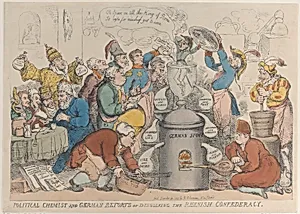
Political Chemist and German Retorts or Dissolving the Rhenish Confederacy
Medium
Hand-colored etching
Dimensions
Sheet: 9 3/4 × 13 3/4 in. (24.7 × 34.9 cm)
Classification
Prints
Department
Drawings and Prints
Museum
Metropolitan Museum of Art, New York, NY
Credit
The Elisha Whittelsey Collection, The Elisha Whittelsey Fund, 1959
Accession Number
59.533.1523
Rights
Public Domain
Tags
Art Historical Context
In the turbulent final years of the Napoleonic Wars, this hand-colored etching from December , 1813, captures the spirit of British satire through the masterful hand of Thomas Rowlandson, by Rudolph Ackermann in London. Titled *Political Chemist and Germanorts or Dissolving thehenish Confederacy*, it measures a modest 9¾ × 13¾ inches and skewers Napoleon Bonaparte as a mad alchemist amid a chaotic laboratory of European monarchs—including Prussia's Frederick William III,'s Francis II, Saxony's Frederick Augustus I, Württemberg's Frederick I, Sweden's Karl XIV Johan, Tsar Alexander I, and even Pope Pius VII. These leaders, depicted as retorts and bubbling flasks, symbolize the unraveling of Napoleon's Rhenish Confederation, a short-lived German puppet alliance crumbling as the Sixth Coalition rose against French dominance. The etching's vibrant hand-coloring enhances its biting humor, a technique typical of Regency-era caricatures that made political commentary accessible and collectible. Rowlandson's exaggerated, grotesque figures—Rowlandson's signature style—turn high-stakes diplomacy into farce, mocking Napoleon's imperial overreach just months after his disastrous Russian campaign. Housed in the Metropolitan Museum of Art's Drawings and Prints department, this print from The Elisha Whittelsey Collection exemplifies how satire fueled anti-Napoleonic sentiment across Europe, blending artistry with propaganda in a pivotal moment of geopolitical realignment.
About the Artist
Frederick William III, King of Prussia|Rudolph Ackermann, London|Francis II, Holy Roman Emperor|Frederick Augustus I, King of Saxony|Pope Pius VII|Frederick I, King of Württemberg|Thomas Rowlandson|Tsar Alexander I|Napoléon Bonaparte|Karl XIV Johan, King of Sweden and Norway (Austrian|British|Russian|French| |British|Swedish|British) · 1768 |1757 |1777 |1769 |1797 |1750 |1792 |1764 –1835 |1827 |1825 |1821 |1840 |1850 |1837 |1834
Austrian, Florence 1768–1835 Vienna|British, London 1757–1827 London|Russian, 1777–1825|French, Ajaccio 1769–1821 St. Helena| |British, active 1805–8|Swedish, Stockholm 1792–1837 St. Gallen|British, active 1794–1829