
Polonaise Carpet
Unknown Artist
17th century
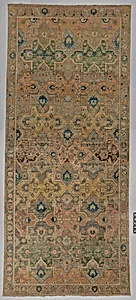
Medium
Cotton (warp and weft), silk (weft and pile), metal wrapped thread; asymmetrically knotted pile, brocaded
Dimensions
L. 160 in. (406.4 cm) W. 69 5/8 in. (176.8 cm)
Classification
Textiles-Rugs
Department
Islamic Art
Museum
Metropolitan Museum of Art, New York, NY
Credit
Gift of John D. Rockefeller Jr., 1950
Accession Number
50.190.1
Rights
Public Domain
Art Historical Context
Step into the opulent world of 17th-century Safavid with the *Polonaise Carpet*, a textile from the Islamic Art collection at The Metropolitan Museum of Art. for their popularity among Polish nobility—where they adorned royal courts—these rugs represent a pinnacle of Persian carpet weaving during the Safavid dynasty (1501–1736), a golden age of artistic patronage and international trade. This grand piece, gifted by John D. Rockefeller. in 1950, measures an impressive 160 inches long by nearly 6 feet wide, perfect for palatial halls. Crafted with cotton warp and weft, shimmering silk pile and weft, and metal-wrapped threads, the carpet employs an asymmetrically knotted pile technique—typical of Persian weaving—enhanced by brocading. This luxurious method outlines motifs with metallic accents, creating a radiant, jewel-like effect that catches the light, blending functionality with extravagance. Polonaise carpets symbolize cultural fusion, as Safavid artisans incorporated European floral influences while preserving intricate Islamic patterns. They highlight the era's global exchanges, where Persian luxury goods captivated distant elites, offering visitors a tactile glimpse into a vanished world of splendor.