
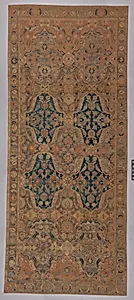
'Polonaise' Carpet
Unknown Artist
first half 17th century
Medium
Cotton (warp and weft), silk (weft and pile), metal wrapped thread; asymmetrically knotted pile, brocaded
Dimensions
Rug: L. 161 in. (408.9 cm) W. 68 1/2 in. (174 cm)
Classification
Textiles-Rugs
Department
Islamic Art
Museum
Metropolitan Museum of Art, New York, NY
Credit
Gift of John D. Rockefeller Jr., 1950
Accession Number
50.190.3
Rights
Public Domain
Tags
Art Historical Context
Step into the opulent world of 17th-century Islamic art with the *Polonaise* Carpet, a magnificent rug from the first half of that century. Housed in the Metropolitan Museum of Art's Department of Islamic Art, this textile masterpiece measures an impressive 161 inches long by 68½ inches wide, evoking the grandeur of royal courts. The name "Polonaise" refers to these luxurious Persian carpets, prized by Polish nobility and exported across Europe during the Safavid dynasty's golden age of weaving. Crafted with cotton warp and weft, silk weft and pile, and shimmering metal-wrapped threads, the carpet showcases advanced techniques like asymmetrically knotted pile—a hallmark of Persian rug-making—and brocading for added texture and luster. These methods created a densely patterned surface, likely adorned with vibrant floral motifs, symbolizing paradise gardens in Islamic tradition and appealing to European tastes for exotic splendor. A generous gift from John D. Rockefeller Jr. in 1950, this rug highlights the global trade in luxury goods, bridging Eastern artistry with Western collectors. Its preservation offers a tactile glimpse into the era's cultural exchanges and masterful craftsmanship.