
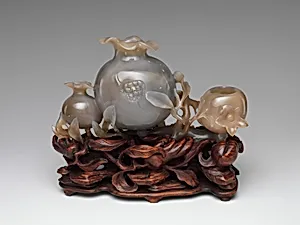
清 瑪瑙石榴擺件|Pomegranates
Unknown Artist
18th century
Medium
Agate
Dimensions
H. 4 1/2 in. (11.4 cm); W. 7 1/2 in. (19.1 cm)
Classification
Hardstone
Culture & Period
China · Qing dynasty (1644–1911)
Department
Asian Art
Museum
Metropolitan Museum of Art, New York, NY
Credit
Gift of Heber R. Bishop, 1902
Accession Number
02.18.887
Rights
Public Domain
Tags
Art Historical Context
This exquisite agate carving, titled *Pomegranates* (清 瑪瑙石榴擺件), dates to the 18th century during China's Qing dynasty (1644–1911). Crafted translucent agate—a prized hardstone—the piece measures just 4½ inches high and 7½ wide, making it a delicate display ornament perfect for a scholar's desk or imperial collection. Its vibrant reddish hues and natural veining mimic ripe pomegranates split open, revealing seeds in masterful detail, showcasing the lapidary artist's skill in exploiting the stone's inherent patterns. In Qing China, hardstone carvings like this exemplified imperial patronage of the arts, where artisans transformed raw minerals into symbolic treasures. Pomegranates held deep cultural significance as emblems of fertility, abundance, and numerous progeny—auspicious motifs often gifted during weddings or celebrations. The technique of thin slicing and precise hollowing highlights the era's technical prowess, rivaling jade work but prized for agate's luminous glow. Now in the Metropolitan Museum of Art's Asian Art Department, this piece was a 1902 gift from collector Heber R. Bishop. It invites visitors to marvel at how Qing craftsmen turned nature's bounty into enduring symbols of prosperity.