
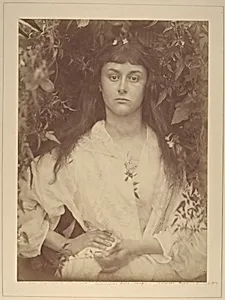
Pomona
September 1872
Medium
Albumen silver print from glass negative
Dimensions
Image: 14 5/16 × 10 3/8 in. (36.3 × 26.4 cm) Sheet: 14 5/16 × 10 3/8 in. (36.3 × 26.4 cm) Mount: 19 5/8 in. × 14 5/8 in. (49.8 × 37.2 cm)
Classification
Photographs
Department
Photographs
Museum
Metropolitan Museum of Art, New York, NY
Credit
David Hunter McAlpin Fund, 1963
Accession Number
63.545
Rights
Public Domain
Tags
Art Historical Context
Julia Margaret Cameron's *Pomona* (September 1872) exemplifies the Victorian photographer's innovative approach to portraiture, blending classical mythology with intimate human expression. Cameron, who began her career in her late forties on the Isle of Wight, transformed photography mere documentation into poetic artistry. Here, the title evokes Pomona, the Roman goddess orchards and abundance, suggesting the sitter—likely a family member or local model posed as a mythical figure—embodies ethereal beauty and natural harmony. This albumen silver print from a glass negative captures Cameron's signature soft-focus style, where deliberate blurring and dramatic lighting create a dreamlike, painterly effect reminiscent of Pre-Raphaelite ideals. The medium, a hallmark of 19th-century photography, involved coating paper with egg whites for rich tonal depth and permanence, while glass negatives allowed for detailed yet manipulable images. Cameron's wet-collodion process demanded swift execution in dim studios, heightening the work's improvisational magic. Measuring about 14½ × 10⅜ inches, *Pomona* entered the Metropolitan Museum of Art via the David Hunter McAlpin Fund in 1963, underscoring its place in photography's evolution from craft to fine art. This portrait not only showcases women's pivotal roles in Cameron's oeuvre but also reflects broader cultural fascinations with mythology amid industrialization, inviting viewers to ponder timeless femininity through a Victorian lens.
About the Artist
Julia Margaret Cameron · 1815–1879
Julia Margaret Cameron (1815–1879), born Julia Margaret Pattle in Calcutta, India, emerged as one of the 19th century's most innovative photographers despite beginning her career at age 48. The daughter of East India Company official James Pattle and French aristocrat Adeline de l'Etang, she was educated in France from 1818 to 1834 alongside her six surviving sisters, renowned for their beauty and...