
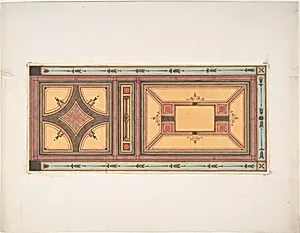
Pompeiian Design for Paneling
second half 19th century
Medium
Pen and black ink, watercolor, and gouache
Dimensions
8 5/8 x 4 in. (21.9 x 10.1 cm)
Classification
Drawings
Department
Drawings and Prints
Museum
Metropolitan Museum of Art, New York, NY
Credit
Dodge Fund, 1967
Accession Number
67.827.89
Rights
Public Domain
Art Historical Context
In the lavish world of 19th-century interior design, *Pompeiian Design for Paneling by French artists Jules-Edmond-Charles Lachaise and Eugène-Pierre Gourdet captures era's fascination with ancient Roman. Created in the second half of 1800s, this delicate drawing reflects the Pompeian Revival movement, sparked by excavations at Pompeii and Herculaneum. Architects and designers eagerly revived the vibrant frescoes and motifs—think scrolling vines, mythical figures, and bold geometric patterns—for modern homes and grand public spaces, blending antiquity with contemporary elegance. Rendered in pen and black ink with watercolor and gouache on a modest 8 5/8 x 4 in. sheet, the work showcases meticulous drafting techniques. The ink provides precise outlines, while gouache's opaque vibrancy mimics the saturated colors of Pompeian walls, making it an ideal presentation drawing for clients or craftsmen. Housed in The Metropolitan Museum of Art's Drawings and Prints department (acquired via the Dodge Fund in 1967), this piece highlights how such designs bridged art and architecture, influencing opulent interiors from Parisian salons to American Gilded Age mansions. Step closer to admire how Lachaise and Gourdet's collaboration evokes timeless luxury—proof that the ghosts of Pompeii still inspired creativity long after the ashes settled.
About the Artist
Jules-Edmond-Charles Lachaise|Eugène-Pierre Gourdet · 1897–1897
Jules-Edmond-Charles Lachaise, born Jules Lachaise on September 2, 1836, in Paris, emerged as a prominent French painter and draughtsman specializing in lavish interior decorations during the Second Empire and beyond. Little is known about his early life and formal training, though he married Berthe Gourdet in 1866, forging a close professional partnership with her brother, the decorator Eugène-Pi...