
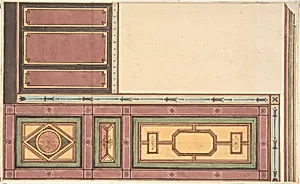
Pompeiian Design for Paneling
second half 19th century
Medium
Pen and black ink, watercolor
Dimensions
9 5/16 x 5 11/16 in. (23.6 x 14.4 cm)
Classification
Drawings
Department
Drawings and Prints
Museum
Metropolitan Museum of Art, New York, NY
Credit
Dodge Fund, 1967
Accession Number
67.827.88
Rights
Public Domain
Art Historical Context
This delicate drawing, *Pompeiian Design foring*, created by French Jules-Edmond-Charles Lise and Eugène-Pierredet in the second half of the 19th century captures the era's fascination ancient Roman aesthetics. Rendered in pen and black ink with watercolor a modest sheet measuring 9 5/16 x 5 11/16 inches, it presents an elegant pattern for interior wall paneling inspired by the vibrant frescoes unearthed at Pompeii. Such designs were highly sought after during the Victorian period, blending archaeological revival with contemporary decorative arts to bring classical grandeur into bourgeois homes. The artwork exemplifies the 19th-century historicist movement, where rediscoveries from Pompeii—buried since 79 AD—influenced European interiors, from wallpapers to furniture. Lachaise and Gourdet, known for their contributions to ornamental design, skillfully adapted Pompeian motifs like garlands, urns, and architectural frames into repeatable panels, showcasing the precision of ink lines for structure and watercolor's subtle hues for lifelike depth. This medium was ideal for presentation drawings, allowing architects and decorators to pitch ideas vividly to clients. Acquired by The Metropolitan Museum of Art through the Dodge Fund in 1967, this piece offers a window into how 19th-century tastemakers revived antiquity, bridging ancient artistry with modern luxury. Visitors can appreciate its timeless appeal in the Drawings and Prints department.
About the Artist
Jules-Edmond-Charles Lachaise|Eugène-Pierre Gourdet · 1897–1897
Jules-Edmond-Charles Lachaise, born Jules Lachaise on September 2, 1836, in Paris, emerged as a prominent French painter and draughtsman specializing in lavish interior decorations during the Second Empire and beyond. Little is known about his early life and formal training, though he married Berthe Gourdet in 1866, forging a close professional partnership with her brother, the decorator Eugène-Pi...