
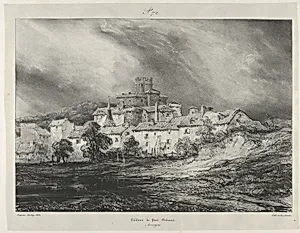
Pont-Gibaud Castle
Medium
Lithograph in black on light gray chine collé laid down on ivory wove paper; only state
Dimensions
Sheet: 14 9/16 × 21 9/16 in. (37 × 54.8 cm) Image: 8 11/16 × 12 3/16 in. (22 × 31 cm)
Classification
Prints
Department
Drawings and Prints
Museum
Metropolitan Museum of Art, New York, NY
Credit
Gift of William M. Ivins Jr., 1922
Accession Number
22.85.1
Rights
Public Domain
Tags
Art Historical Context
In the Romantic spirit of early 19th-century France, *Pont-Gibaud Castle* (1830) captures the evocative ruins of a medieval fortress in Auvergne through the masterful collaboration of painter Eugène Isabey and lithographer Godefroy Engelmann. Isabey, known for his dramatic seascapes and architectural scenes, sketched the castle's towering silhouette against a moody sky, evoking the sublime beauty of nature reclaiming human grandeur. Engelmann, a pioneer in lithography, translated this into a crisp black-ink print on light gray chine collé—a delicate technique where a thin Chinese paper absorbs fine details before being mounted on sturdy ivory wove support, allowing for subtle tonal gradations rare in early prints. This sole-state lithograph, measuring about 9 by 12 inches in its image area, exemplifies lithography's revolutionary role in democratizing art. Invented just decades earlier, the medium enabled affordable reproductions of drawings, bridging fine art and popular illustration during France's July Monarchy. Donated to the Metropolitan Museum of Art in 1922, it invites visitors to ponder Pont-Gibaud's storied past as a 12th-century stronghold, its weathered stones a testament to time's enduring poetry. A charming window into Romantic fascination with Gothic architecture!
About the Artist
Eugène Isabey|Godefroy Engelmann · 1803–1886
Eugène Isabey (1803–1886) was a French painter and lithographer known for his dramatic seascapes, coastal scenes, and historical compositions. Born in Paris, he was the son of the celebrated miniaturist and portraitist Jean-Baptiste Isabey, who provided his early artistic training. The younger Isabey studied briefly with various masters but was largely shaped by his father's studio and by his own ...