
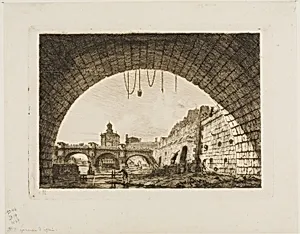
Pont-Neuf and the Samaritaine Seen from Under the First Arch of the Pont-au-Change, Paris
1855, after a drawing of the mid–1780s
Medium
Etching in dark brown on ivory laid paper
Dimensions
Image, including stray marks: 14.5 × 20.4 cm (5 3/4 × 8 1/16 in.); Plate: 14.5 × 20.4 cm (5 3/4 × 8 1/16 in.); Sheet: 19.2 × 24.4 cm (7 9/16 × 9 5/8 in.)
Classification
etching
Department
Prints and Drawings
Museum
Art Institute of Chicago
Accession Number
63832
Rights
Public Domain
Art Historical Context
Step into the shadowy arch of Paris's Pont-au-Change Charles Meryon's captivating etching *Pont-Neuf and theitaine Seen from Under the First Arch of the Pont-Change, Paris* (1855). This view peers toward the iconic Pont-Neuf—the city's oldest standing bridge—and the ornate Samaritaine building, a Renaissance landmark that once housed a famous pump and later a department store. Rendered after a drawing from the mid1780s, the work bridges the 18th and 19th centuries, preserving a pre-Haussmann glimpse of medieval Paris along the Seine. Meryon, a pioneering French etcher often hailed as the "Rembrandt of Paris," elevated etching to new heights with his obsessive detail and atmospheric depth. Working in the Romantic tradition, he documented the Gothic spires and bustling quays of old Paris just before Baron Haussmann's sweeping urban renovations transformed the city. This piece exemplifies his skill in evoking mood through intricate linework, capturing the play of light on stone and water. Printed in dark brown ink on ivory laid paper (14.5 × 20.4 cm image), the etching's rich tonality and fine textures reveal Meryon's technical mastery, making architecture feel alive and timeless. Now in the Art Institute of Chicago's Prints and Drawings Department, it invites visitors to savor a vanished Paris with wonder.
About the Artist
Charles Meryon · 1821–1868
Charles Meryon, born on November 23, 1821, in Paris, was the illegitimate son of English physician Dr. Charles Lewis Meryon and dancer Pierre-Narcisse Chaspoux (stage name Narcisse Gentil) at the Paris Opéra. His half-sister Fanny, from his mother's prior relationship with Viscount Lowther, remained in contact after their mother's death in 1838. Raised partly outside Paris before attending Pension...